The Time of the Book of Judges

Updated: Mar 10
Charles E. Stolfus
Chronological Study of the Bible
Lay Institute Spring 2018
The Judges and the Monarchy
9. The Time of the Judges
The Nation Fails the Conquest of Canaan
Introduction
• The Beginnings
• The Age of the Patriarchs
• The Exodus out of Egypt
• The Wilderness Wanderings
• Camped at Mt Sinai
• Journey to the Promised Land
• Camped on the Plains of Moab
• The Conquest of Canaan
The Period of the Judges
• This period is described in the Book of Judges and Ruth
• The period runs from c. 1380 BC--Joshua died at the age of 110 in 1383 BC (cf. Josh.
24:29) --to c.1050 with the annointing of the first King Saul
o Samuel (c. 1105- 1030 BC) was the last of the Judges and was the one directed by
God to annoint Saul
• This period is characterized by the type of political and spiritual rulers leading the
Nation—the Judges
o The Hebrew for Judges means “deliverers” or “saviors”
o 13 Judges are identified as ruling during the period covered by Judges (Eli and
Samuel make for a total number of 15 Judges)
o This covers approx. 350 years between the conquest of the Land under Joshua and
the anointing of the first King Saul in c. 1043 BC
• This period is characterized by moral and spiritual decline and apostasy. As such, it
stands in sharp contrast to the period of Conquest under Joshua:
Josh. 21:43 So the LORD gave Israel all the land which He had sworn to give to their
fathers, and they possessed it and lived in it. 44 And the LORD gave them rest on every side,
according to all that He had sworn to their fathers, and no one of all their enemies stood before them; the LORD gave all their enemies into their hand. 45 Not one of the good promises which the LORD had made to the house of Israel failed; all came to pass.
Judges Of Israel Length Of Rule Verses
1. Othniel 40 years (Judg 3:9-11)
2. Ehud 80 years (Judg 3:15-30)
3. Shamgar Unknown (Judg 3:31)(Judg 5:6)
4. Deborah/Barak 40 years (Judg 4:4-5:31)
5. Gideon 40 years (Judg 6:11-8:32)
6. * Abimelech 3 years (Judg 9:1-57)(2 Sam 11:21)
7. Tola 23 years (Judg 10:1-2)
8. Jair 22 years (Judg 10:3-5)
9. Jephthah 6 years (Judg 11:1-12:7)
10. Ibzan 7 years (Judg 12:8-10)
11. Elon 10 years (Judg 12:11-12)
12. Abdon 8 years (Judg 12:13-15)
13. Samson 20 years (Judg 13:1-16:31)
14. Eli 40 years (1 Sam 1:1-4:18)
15. Samuel 12 years (app) (1 Sam 2:18-4:1)(1 Sam 7:2-8:1)
Until Saul made king
*It is questionable whether Abimelech should count as a Judge
5 Reasons Are Cited For The Defection From God
1. Israel failing to completely drive out the Canaanites (Judges 1:19, 21, 35)
1:19 Now the LORD was with Judah, and they took possession of the hill country; but
they could not drive out the inhabitants of the valley because they had iron chariots.
2. idolatry (Judges 2:12)
2:12 and they forsook the LORD, the God of their fathers, who had brought them out of
the land of Egypt, and followed other gods from among the gods of the peoples who were around them, and bowed themselves down to them; thus they provoked the LORD to anger.
3. intermarriage with the Canaanites Judges 3:5, 6)
3:5 And the sons of Israel lived among the Canaanites, the Hittites, the Amorites, the
Perizzites, the Hivites, and the Jebusites; 6 and they took their daughters for themselves as
wives, and gave their own daughters to their sons, and served their gods.
4. failing to follow the leadership of the Judges (Judges 2:16-17)
2:16 Then the LORD raised up judges who delivered them from the hands of those who
plundered them. 17 And yet they did not listen to their judges, for they played the harlot after
other gods and bowed themselves down to them. They turned aside quickly from the way in
which their fathers had walked in obeying the commandments of the LORD; they did not do as their fathers.
5. turning away from the Lord after the death of the Judges (Judges 2:19)
2:19 But it came about when the judge died, that they would turn back and act more
corruptly than their fathers, in following other gods to serve them and bow down to them; they
did not abandon their practices or their stubborn ways.
While there were 15 total Judges during this period, 7 cycles of God’s dealings with the
Nation are highlighted in this book (sin to salvation progression; Judges 2:11-19):
the moral defection of the people (Judges 2:11-13)
2:11 Then the sons of Israel did evil in the sight of the LORD, and served the Baals, 12
and they forsook the LORD, the God of their fathers, who had brought them out of the land of
Egypt, and followed other gods from among the gods of the peoples who were around them, and bowed themselves down to them; thus they provoked the LORD to anger. 13 So they forsook the LORD and served Baal and the Ashtaroth.
2. the Lord is angered and raised up a foreign nation to oppress and punish the
Israelites (Judges 2:14-15)
“14 And the anger of the LORD burned against Israel, and He gave them into the hands
of plunderers who plundered them; and He sold them into the hands of their enemies around
them, so that they could no longer stand before their enemies. 15 Wherever they went, the hand of the LORD was against them for evil, as the LORD had spoken and as the LORD had sworn to them, so that they were severely distressed.”
3. the Nation cried out to God for mercy (Judges 2:18b)
“. . . for the LORD was moved to pity by their groaning because of those who oppressed
and afflicted them.”
4. The Lord listened to the cries of the people and raised up a deliverer for the
people (Judges 2:18a)
“2:18 And when the LORD raised up judges for them, the LORD was with the judge and
delivered them from the hand of their enemies all the days of the judge; . . .”
5. When the Judge died the people lapse into disobedience again (Judges 2:19)
“2:19 But it came about when the judge died, that they would turn back and act more
corruptly than their fathers, in following other gods to serve them and bow down to them; they
did not abandon their practices or their stubborn ways.”
I. Incomplete Obedience: The Failure to Finish the Conquest of Canaan (Judges 1:1-3:6)
A. The setting:
• Joshua had taken the nation into the land and had led them to a spectacular
victory
• After a Central Campaign, a Southern Campaign, and a Northern Campaign
Joshua had divided up the Land and had charged the 12 Tribes to finish the
Job of occupying the Land and in finishing the job of driving out the
occupants
• During Joshua’s lifetime and the lifetimes of the Elders who helped him lead
the Nation the nation had walked in obedience. (Judges 2:7)
Joshua 2:7 And the people served the LORD all the days of Joshua, and all the days of the elders who survived Joshua, who had seen all the great work of the LORD which He had done for Israel.
B. The Consequences of Israel’s continued disobedience:
1. During the final days of Joshua’s life the Nation had begun to
compromise. At one point God visited the Nation in the form of the Angel
of the Lord and rebuked them for their failure to fully obey God in
occupying the Land and in failing to remain wholly devoted to the Lord.
The Nation then made a half-hearted attempt to obey the Lord. (Judges
2:1-6)
2:1 Now the angel of the LORD came up from Gilgal to Bochim. And he said, “I brought you
up out of Egypt and led you into the land which I have sworn to your fathers; and I said, I will
never break My covenant with you, 2 and as for you, you shall make no covenant with the
inhabitants of this land; you shall tear down their altars. But you have not obeyed Me; what is
this you have done? 3 “Therefore I also said, ‘I will not drive them out before you; but they
shall become as thorns in your sides, and their gods shall be a snare to you.’” 4 And it came
about when the angel of the LORD spoke these words to all the sons of Israel, that the people
lifted up their voices and wept. 5 So they named that place Bochim; and there they sacrificed to the LORD. 2:6 When Joshua had dismissed the people, the sons of Israel went each to his
inheritance to possess the land.
• Joshua finally died, along with the Elders.
7 And the people served the Lord all the days of Joshua, and all the days of the elders who
survived Joshua, who had seen all the great work of the Lord which He had done for Israel. 8
Then Joshua the son of Nun, the servant of the Lord, died at the age of one hundred and ten.
And they buried him in the territory of his inheritance in Timnath-heres, in the hill country of
Ephraim, north of Mount Gaash.
• The new generation was now “leading” the Nation. (Judges 2:10)
2:10 And all that generation also were gathered to their fathers; and there arose another
generation after them who did not know the LORD, nor yet the work which He had done for
Israel.
B. The Disobedience of the Nation Described
• Israel had been charged and warned under Moses to completely and utterly
drive out the Canaanites and the occupants of the Land:
Ex. 23:24 “You shall not worship their gods, nor serve them, nor do according to their deeds;
but you shall utterly overthrow them, and break their sacred pillars in pieces.
Deut. 4:25 “When you become the father of children and children’s children and have remained long in the land, and act corruptly, and make an idol in the form of anything, and do that which is evil in the sight of the LORD your God so as to provoke Him to anger, 26 I call heaven and earth to witness against you today, that you shall surely perish quickly from the land where you are going over the Jordan to possess it. You shall not live long on it, but shall be utterly destroyed. 27 “And the LORD will scatter you among the peoples, and you shall be left few in number among the nations, where the LORD shall drive you. 28 “And there you will serve gods, the work of man’s hands, wood and stone, which neither see nor hear nor eat nor smell. 29 “But from there you will seek the LORD your God, and you will find Him if you search for Him with all your heart and all your soul. 30 “When you are in distress and all these things have come upon you, in the latter days, you will return to the LORD your God and listen to His voice. 31 “For the LORD your God is a compassionate God; He will not fail you nor destroy you nor forget the covenant with your fathers which He swore to them.
Deut. 7:2 and when the LORD your God shall deliver them before you, and you shall defeat
them, then you shall utterly destroy them. You shall make no covenant with them and show no
favor to them.
Deut. 12:2 “You shall utterly destroy all the places where the nations whom you shall dispossess
serve their gods, on the high mountains and on the hills and under every green tree.
Deut. 20:17 “But you shall utterly destroy them, the Hittite and the Amorite, the Canaanite and
the Perizzite, the Hivite and the Jebusite, as the LORD your God has commanded you,
HOWEVER: Following the death of Jushua and the Elders the nation of Israel failed to
completely obey the Lord:
• Judah and Simeon: (1:19)
“19 Now the LORD was with Judah, and they took possession of the hill country; but they could not drive out the inhabitants of the valley because they had iron chariots.”
• Manassah (1:27-28)
“27 But Manasseh did not take possession of Beth-shean and its villages, or Taanach and its
villages, or the inhabitants of Dor and its villages, or the inhabitants of Ibleam and its villages, or the inhabitants of Megiddo and its villages; so the Canaanites persisted in living in that land. 28 And it came about when Israel became strong, that they put the Canaanites to forced labor, but they did not drive them out completely.
• Ephraim (1:29)
29 Neither did Ephraim drive out the Canaanites who were living in Gezer; so the Canaanites
lived in Gezer among them.
• Zebulun (1:30)
Judg. 1:30 Zebulun did not drive out the inhabitants of Kitron, or the inhabitants of Nahalol; so
the Canaanites lived among them and became subject to forced labor.
• Asher (1:31-32)
Judg. 1:31 Asher did not drive out the inhabitants of Acco, or the inhabitants of Sidon, or of
Ahlab, or of Achzib, or of Helbah, or of Aphik, or of Rehob. 32 So the Asherites lived among
the Canaanites, the inhabitants of the land; for they did not drive them out.
• Naphtali (1:33)
Judg. 1:33 Naphtali did not drive out the inhabitants of Beth-shemesh, or the inhabitants of Beth-anath, but lived among the Canaanites, the inhabitants of the land; and the inhabitants of Beth-shemesh and Beth-anath became forced labor for them.
• Dan (1:34-36)
Judg. 1:34 Then the Amorites forced the sons of Dan into the hill country, for they did not allow them to come down to the valley; 35 yet the Amorites persisted in living in Mount Heres, in Aijalon and in Shaalbim; but when the power of the house of Joseph grew strong, they became forced labor. 36 And the border of the Amorites ran from the ascent of Akrabbim, from Sela and upward.
C. The author then describes the principles of operation during the Period of the
Judges including God’s responses
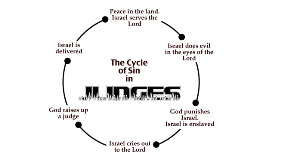
1. The principles described:
a. Israel sins and forsakes the Lord
Judg. 2:11 Then the sons of Israel did evil in the sight of the Lord, and served the Baals, 12 and
they forsook the Lord, the God of their fathers, who had brought them out of the land of Egypt, and followed other gods from among the gods of the peoples who were around them, and bowed themselves down to them; thus they provoked the Lord to anger. 13 So they forsook the Lord and served Baal and the Ashtaroth.
b. In God’s anger He delivers them into the hands of their enemies
14 And the anger of the Lord burned against Israel, and He gave them into the hands of
plunderers who plundered them; and He sold them into the hands of their enemies around them, so that they could no longer stand before their enemies. 15 Wherever they went, the hand of the Lord was against them for evil, as the Lord had spoken and as the Lord had sworn to them, so that they were severely distressed.
c. God hears their cries and raises up deliverers (the “Judges”)
16 Then the Lord raised up judges who delivered them from the hands of those who plundered 2. them. 17 And yet they did not listen to their judges, for they played the harlot after other gods and bowed themselves down to them. They turned aside quickly from the way in which their fathers had walked in obeying the commandments of the Lord; they did not do as their fathers. 18 And when the Lord raised up judges for them, the Lord was with the judge and delivered them from the hand of their enemies all the days of the judge; for the Lord was moved to pity by their groaning because of those w to oppressed and afflicted them.
d. When the Judge died the people of Israel turned away from the
Lord and became worse than before
19 But it came about when the judge died, that they would turn back and act more corruptly than their fathers, in following other gods to serve them and bow down to them; they did not abandon their practices or their stubborn ways.
Because of Israel’s persistant sin, God sovereignly refused to enable the
Israelites to finish the job of driving out the Canaanites (Judges 2:20-23)
2:20 So the anger of the LORD burned against Israel, and He said, “Because this nation
has transgressed My covenant which I commanded their fathers, and has not listened to My
voice, 21 I also will no longer drive out before them any of the nations which Joshua left when
he died, 22 in order to test Israel by them, whether they will keep the way of the LORD to walk
in it as their fathers did, or not.” 23 So the LORD allowed those nations to remain, not driving
them out quickly; and He did not give them into the hand of Joshua.
3. God then used the persistant presence of the enemies of Israel to test Israel
(Judges 3:1-6)
Judg. 3:1 Now these are the nations which the LORD left, to test Israel by them (that is,
all who had not experienced any of the wars of Canaan; 2 only in order that the generations of
the sons of Israel might be taught war, those who had not experienced it formerly). 3 These
nations are: the five lords of the Philistines and all the Canaanites and the Sidonians and the
Hivites who lived in Mount Lebanon, from Mount Baal-hermon as far as Lebo-hamath. 4 And
they were for testing Israel, to find out if they would obey the commandments of the LORD,
which He had commanded their fathers through Moses. 5 And the sons of Israel lived among the Canaanites, the Hittites, the Amorites, the Perizzites, the Hivites, and the Jebusites; 6 and they took their daughters for themselves as wives, and gave their own daughters to their sons, and served their gods.
II. A Selected History of the Time of the Judges (Judges 3:7-16:31)
Four Cycles Where the Judge was Good (Judges 3:7-8:32)
A. Othniel vs the Mesopotamians (Judges 3:7-11)
Othniel:8 yrs oppression/40 yrs rest
B. Ehud and Shamgar vs the Moabites (Judges 3:12-31)
Ehud: 18 yrs oppression/80 yrs rest
Shamgar: not given/not given
C. Deborah vs the Canaanites (Judges 4:1-5:31)
Deborah: 20 yrs oppression/40 yrs rest
D. Gideon vs the Mideonites (Judges 6:1-8:32)
Gideon: 7yrs oppression/40 yrs rest
1 The People Finally Remember YHWH--The Cycle of Sin, Servitude,
Supplication is Repeated: 6:1-6
2 YHWH’S People Are Prepared Spiritually: 6:7-32
The people are Reminded of Broken Covenant: YHWH sends the
people a prophet to remind them that they are suffering because
they have broken the covenant 6:7-10
The Servant Is Prepared to Follow: 6:11-24
(1) YHWH commissions a cynical Gideon to deliver Israel
from Midian 6:11-16
(2) YHWH confirms to a doubting Gideon that it is He who is
speaking in peace 6:17-24
The People Are Prepared to Follow: 6:25-32
(1) When YHWH ordered Gideon to tear down the idols of his
father and build an alter and sacrifice to Him, He did so
timidly 6:25-27
(2) Nicknaming Gideon ‘fighter of Baal’ His father protects
him and encourages the people to let the true God fight
here 6:28-32
The Enemy is Defeated: 6:33--8:21
YHWH confirms for Gideon and the People His Defeat of the
Midianites through Them: 6:33--7:15a
(1) The people from the east enter the land and Gideon sends
for all in Israel to gather and fight 6:33-35
(2) Once again out of personal doubt Gideon seeks
confirmation from God of His will 6:36-40
(3) With so many men available YHWH cuts the number from
32,000 to 300 so that they will see YHWH as the cause of
victory 7:1-8
(4) YHWH gives fearful Gideon confirmation that he will be
victorious in the battle with the Medianites 7:9-15a
The Battle is Won: The battle is described as one which God
supernaturally won and allowed Israel to clean up on with the dead
leaders 7:15b-25
Gideon Calms the Ephraimites: Gideon calms the anger of the
Ephraimites by proclaiming their deeds in capturing the kings as
greater than his deeds 8:1-3
The Enemy is Complete Eliminated and its protectors Disciplined
by Gideon 8:4-21
(1) Running into discouragement at Succoth and Penuel who
refuse to be a part of God’s working, Gideon promises that
they will loose their lives later 8:4-9
(2) Zebah and Zalmunna are captured by Gideon 8:10-12
(3) Succoth and Penuel are provided for in a talionic way for
their evil against YHWH 8:13-17
(4) Gideon seeks personal revenge by killing Zebah and
Zalmunna 8:18-21
The End of Gideon’s Reign: 6:22-32
a) Although Gideon refused to stand in YHWH’s place as king, he
did error in erecting an ephod which Israel later worshiped 8:22-27
b) Midian was defeated and the land was in peace for forty years
while Gideon lived like a king, died at an old age and was buried
in his fathers Joash’s tomb 8:28-32
Three Cycles Where the Judge was Evil (Judges 8:33-16:31)
Tola and Jair vs the influence and legacy of Abimelech (Judges 8:33-10:5)
Abimelech: ruled over Israel 3 years
Tola: Judged Israel 23 years
Jair: Judged Israel 22 years
Abimelech: Even through God mercifully offered an opportunity for those sinning to repent, He also allowed their continued evil to come upon them 8:33--10:5
1 Cycle Repeated--People Sink in Sin: When Gideon was dead after the
forty years of peace, Israel forgot God’s deliverance and sinned again
returning to Baal 8:33-35
2) A Sinful Man, Abimelech, Rises to Lead a Sinful People: 9:1-6
a) Formulating his father’s flirtations, Abimelech has his mother’s
family and Shechem appoint him as king 9:1-4
b) Killing all of his brothers, save Jotham, Abimelech is pronounced
king in Shechem 9:5-6
3) An Opportunity for These Sinful People to Choose: Jotham stands on the
mount of blessing (Mt. Gerizim [Dt. 27] and in a parable questions
integrity and prophecies judgment 9:7-21
4) The People Choose Evil: Abimelech reigned three years 9:22
5) God Allowed Evil to Reign Upon An Evil and Rebellious People: 9:23-57
a) God’s Allowance of Evil to Work: God allowed an evil spirit to
come between Abimelech and his people so as to bring back upon
them their evil 9:23-25
b) The People of Shechem Rebel: The Shechemites join themselves
behind a man named Gaal who encourages rebellion from
Abimelech to Hamor 9:26-29
c) Abimelech Defeats the Military of Shechem: Under the sneaky
protection of Zubul, his lieutenant, Abimelech ambushed Shechem
and Gaal 9:30-41
d) Abimelech Defeats the Common People of Shechem: Abimelech
completely defeated, slew and raised the city the next day 9:42-45
e) Abimelech Defeated the Leaders of Shechem: Abimelech burned
alive all of the leaders and their families in Shechem 9:46-49
f) Abimelech (the Strong) was Killed (by the Weak)--Talionic:
Abimelech died in an attempt to capture Thebez by a strong
woman and the sword of his armor bearer
g) The People Are Left Floundering: With the death of Abimelech all
of the men of Israel left the battle 9:55
h) God’s Principle in Dealing with These Evil Ones: God used men to
bring about evil upon the evil--Abimelech and Shechem 9:56-57
6 A Period of Peace for the Nation: 9:1-2
a) Tola’s Reign for 20 years as Judge: After the evil of Abimelech,
Tola arose to deliver Israel for 23 years 10:1-2
b) Jair’s Reign for 22 Years as Judge: Jair and his 30 sons reigned
with influence for 22 years 10:3-5
F. Jepthah, Ibzan, and Abdon vs. the Philistines and the Ammonites (10:6-12:15)
Jephthah: 18 yrs oppression/ judged Israel 6 years
Ibzan: Judged Israel 7 years
Elon: Judgeed Israel 10 years
Abdon: Judged Israel 8 years
Jephthah: As sin continued to infect the nation and its leaders (Judges), YHWH allowed more
evil to reign in the midst of deliverance 10:6--12:15
1 A Spiritual Battle Reoccurred, Was Clarified and Decided Upon: 10:6--
11:28
a) Israel Returned to Sin and Idolatry: Israel once again turned from
serving YHWH to the gods of the people surrounding them 10:6
b) God Gave the Nation into Servitude: 10:7-8
(1) God once again allowed Israel to be sold into bondage--this
time to the Philistines and the Ammorites 10:7
(2) Israel became greatly afflicted for 18 years--especially by
the Ammorites 10:8
c) Israel Repented of Their Sin (Negotiated with YHWH) and
YHWH Had Mercy [Based upon His Covenant]: 10:9-16b
(1) Israel Repented and confessed their idolatrous sin to
YHWH 10:9
(2) YHWH reminded the nation of his historical deliverance of
them in their past and his refusal to help them in their
rebelliousness 10:11-14
(3) Israel confessed sin and took steps toward upright living
toward YHWH 10:15-16a
(4) YHWH responded to his people’s great need as a loving
father with hurt child 10:16b
d) Lining Up for Battle, Israel Humbly Asked Jephthah to Lead
Them: 10:17--11:11
(1) Israel and Ammon came together for battle, but Israel did
not have a leader 10:17-18
(2) Israel had to humble itself to ask Jephthah to lead them
even through they had done evil to him 11:1-11
e) Reminder the War Is YHWH’s: In letters sent to the king of
Ammon, Jephthah presented their possession of the land as that
which YHWH gave from the Amorites 11:12-28
2 The Physical Battle Was Fought and Won over Ammon by Israel and
Jephthah through YHWH 11:29-33
a) By the empowering of the Holy Spirit Jephthah lead Israel against
Ammon 11:29
b) Jephthah vowed to YHWH to give whatever met him at him first if
he won the battle 11:30-31
c) The Lord enabled Jephthah to win against the Ammonites 11:32-
3 Internal Sin Continues to Plague the Nation: A Painful aftermath of the
War with Ammon affects Jephthah and Israel due to poor leadership by
Jephthah 11:34--12:6
a) Jephthah mournfully fulfills his vow to YHWH with his daughter
11:34-40
b) Jephthah is confronted by Ephriam for not including them in the
battle 12:1
c) Jephthah and the men of Ehriam fought only to slay 42,000 from
Ephriam 12:2-6
4 Jephthah’s Death: Jephthah died after judging for six years 12:7
5 Transition--A Period of Three Continual Judges: 12:8-15
a) Ibzan of Bethlehem judged Israel 7 years yet had his children
marry out of the faith 12:8-10
b) Elon, of northern Zebulun, judged Israel for 10 years and died
12:11-12
c) Abdon the Pirathonite judged Israel 8 years with experience of
wealth and royalty 12:13-15
G. Samson vs the Philistines (13:1- 16:31)
Samson: 40 years oppression/ Judged Israel 20 years
Samson: In spite of a sinful people and leadership, YHWH kept his word to deliver his people
13:1--16:31
1 Sin and Servitude--Israel Returns to Evil and Bondage: Israel once again
pursuing evil is placed in bondage to the Philistines for 40 years 13:1
2 A Promise from YHWH in Samson: YHWH promises and gives a
deliverer to Israel through Manoah and his wife named Samson 13:2-14
a) YHWH appeared to Manoah’s wife to announce the birth of a son
through them who would be separated to God to defeat the
Philistines 13:2-5
b) Manoah’s wife reports the message of YHWH to her husband
13:6-7
c) YHWH confirmed his word to Manoah and his wife through the
acceptance of a burnt offering 13:8-23
d) A son is born to Manoah and his wife whom they call “Sun” and
grows up with God’s enrichment 13:24
3 Through corruption and suffering many of the consequences of sin,
Samson is used by YHWH to deliver Israel from the oppressive rule of the
Philistines 13:25--16:31
a) The Spirit of God Works in Samson: The spirit of God began to
work in Samson 13:25
b) Many Philistines die by Samson’s hand but not uprightly--rather
through acts of anger and jealousy with personal hurt 14:1--15:8
(1) Leaving his people, Samson fell in love with a Philistine
and asked his parents to arrange a marriage (God’s
permissive will) 14:1-4
(2)When Samson and his parents go to arrange the wedding,
Samson secretly breaks part of his Nazarite vow 14:5-9
(3) Samson, boasting through a riddle of his conquest of the
lion, is betrayed by his fiancee, looses the bet and his wife
14:10-20
(4) In jealous violence Samson destroyed the corps of the
Philistines only to loose the life of his and wife whereupon
he slaughters more Philistines 15:1-8
Betrayal and Deliverance: Those of Israel tried to deliver their
judge in fear over to the Philistines, but God strengthened Samson
to be victorious and to judge for 20 years 15:9-20
Humiliation of Philistines: Though in Philistine Territory for
relations with a harlot, Samson humiliated their defense by
carrying away their gates 16:1-3
Suffering and Death: Though Samson suffered for breaking his
vow, many Philistines died with Samson for YHWH 16:4-30
(1) Loving a Philistine more than his vow to YHWH, Samson
allowed her to interfere with his vow to YHWH and
suffered servitude 16:4-21
(2) At a banquet where the Philistines acknowledged their god,
Dagon, for their victory Samson was enabled by YHWH to
overcome them 16:22-30
Burial of Samson: Samson was buried with his fathers as a
victorious and tragic judge 16:31
Outlines of the 7 Major Judges from Bible.org
III. Spiritual Depravity of the Nation: A Selected History (Judges 17:1-1:25)
A. The Idolatry of Micah and the Danites (Judges 17:1-18:31)
B. The Crime of Gibeah and War against Benjamin (Judges 19:1-21:25)
IV. The Book of Ruth
A. The Setting
Ruth 1:1 Now it came about in the days when the judges governed, that there was
a famine in the land. And a certain man of Bethlehem in Judah went to sojourn in the land of
Moab with his wife and his two sons.
• Elimelech and Naomi encounter famine in the land of Israel
• They journey to Moab in order to survive.
• Elimelech dies
• Namoi’s 2 sons take wives and then they die
• Naomi hears that “God has visited His people by giving them bread” (1:6) and
she and one of her daughters (Ruth) return to Israel
• God appoints Boaz as a “kinsman-redeemer” to save Ruth
• Boaz receives Ruth in his field, a romance blossoms, and finally Boaz
redeems Ruth
• God rewards Ruth and Boaz with a child
• This child furthers the line of the Messiah
B. Major Themes
• God’s Plan of Redemption extends beyond the Jews to the Gentiles (Ruth is a
Moabite)
• Ruth demonstrates that women are co-heirs with men in God’s salvation grace
• Ruth is an example of the excellent woman of Proverbs 31 (cf. 3:11, “. . . all
the people of my town know that you are a virtuous woman”)
• Ruth describes God’s sovereign and providential care of seemingly
unimportant and insignificant people
o “God had visited His people” –stopping the famine(1:6)
o Ruth “happened to go to the field of Boaz” (2:3)
o “the Lord enabled Ruth to conceive” –as Ruth and Boaz married(4:13)
• Ruth along with Tamar (Gen. 38), Rahab (Josh. 2), and Bathsheba (II Sam.
11-12) stand in the Messianic line
• Boaz is a type of Christ becoming Ruth’s kinsman-redeemer
Bible facts you should know about this amazing Bible book!