Search Results
Search this site
3674 results found
- How Do I Handle the Ache of Loneliness?
And I pray that you, being rooted and established in love, may have power, together with all the Lord’s holy people, to grasp how wide and long and high and deep is the love of Christ.” Ephesians 3:17b-18 (NIV) I don’t like to be in pain. In any way. And if I’m not careful, this aversion to pain can lead to me grabbing for something to fill the deep ache in my soul. Maybe you can relate. When you’re lonely and you see your ex-boyfriend post a picture with a new girl — laughing, holding hands, and looking like the happiest they’ve ever been — your flesh will want to grab at something. It’s hard not to comfort yourself by texting another guy to grab a little attention and make yourself feel better. When you’re listening to other moms talk about all the progress their children are making in reading and your child can’t even identify letters yet, your flesh will want to grab at something. It’s hard not to throw out a statement to one-up the bragging moms in an area where your child is excelling. And all these things we’re tempted to grab at? They won’t fill us the way we think they will. In the end, they only make us feel emptier. But how do we tell our flesh no when we are desperate for relief? I have discovered that the more we fill ourselves from God’s life-giving love, the less we will be dictated by the grabby-ness of our flesh. One of the most beautiful descriptions of the fullness of God is found in Paul’s prayer for the Ephesians: “For this reason I kneel before the Father, from whom every family in heaven and on earth derives its name. I pray that out of his glorious riches he may strengthen you with power through his Spirit in your inner being, so that Christ may dwell in your hearts through faith. And I pray that you, being rooted and established in love, may have power, together with all the Lord’s holy people, to grasp how wide and long and high and deep is the love of Christ, and to know this love that surpasses knowledge — that you may be filled to the measure of all the fullness of God.” (Ephesians 3:14-19, NIV) My favorite part of Paul’s prayer is him asking that we have the power to grasp the fullness of the love of Christ … for then we will be filled with the fullness of God. If we grasp the full love of Christ, we won’t grab at other things to fill us. Or if we do, we’ll sense it. We’ll feel a prick in our spirit when our flesh makes frenzied swipes at happiness and we’ll pause. In this pause we find a great daily choice we can make. Am I willing to tell my flesh no, so that I can say yes to the fullness of God in this situation? And this isn’t about us putting on a brave face and hoping for the best when we feel powerless. We have the power through Christ, who is over every power, including the pull of the flesh. When we have Christ, we are full — fully loved and accepted and empowered to say no. This is true on the days we feel it, and it’s still true when we don’t feel Jesus’ love at all. If we live rooted and established in His love, we don’t just have knowledge of His love in our minds, but it becomes a reality that anchors us. Though winds of hurt blow, they cannot uproot us and rip us apart. His love holds us. His love grounds us. His love is a glorious weight preventing the harsh words and hurtful situations from being a destructive force. We feel the wind but aren’t destroyed by it. This is the “fullness of God.” There is power in really knowing this. This isn’t dependent on what you’ve accomplished. Or on another person loving you or accepting you. Nor is it because you always feel full. You are full, because Christ brought the fullness to you. Yes, I am fully loved, fully accepted, and fully empowered to say no to my flesh. Speak that truth in the power He’s given you. Believe that truth in the power He’s given you. Live that truth in the power He’s given you. That’s how we tell our flesh no. That’s how we live fully prepared in the fullness of God. Father God, thank You for Your love for me that knows no end. Help me look to You and You alone to fill me. I want my roots to go down ever deeper in Your love. In Jesus’ Name, Amen. www.lysaterkeurst.com .
- Here's a God-Centered Grandparent's Guide!
Affirming our grandchildren – it’s key: to building strong relationships, to discipleship, to passing the faith. Our words are powerful. When handled well, they can build up, encourage, communicate love, and convey value to our grandchildren. On the other hand, our disregard in the use of our words, and even our silence, have the effect of performing just the opposite work in the lives of our grandchildren. Knowing this, it’s imperative that we understand AFFIRMATION and learn to practice it well. WHAT IS GOD-CENTERED AFFIRMATION? Words can get muddied. Consider, for example the words: blessing, encouragement, and affirmation. We often use them interchangeably and while there’s nothing wrong with that practice, at their core, these words are distinct in meaning. A BLESSING is a word or action that delivers refreshment and hope to its recipient. According to John Trent , a blessing is the gift of acceptance and unconditional love passed from one generation to another through meaningful touch, a spoken message, attaching high value, picturing a special future and an active commitment. A blessing is live giving, live-changing. ENCOURAGEMENT applies to words or actions that offer support, confidence and hope. Encouragement looks forward, painting a bright future of something that “could be.” Think of it as “cheerleading.” AFFIRMATION , on the other hand, looks backward. It confirms something that has already happened and been observed. “Affirmation is truthfully declaring by complimentary word or action the goodness of something. Good affirmation attests, certifies, or confirms that which honors God, that which is morally upright.”Sam Crabtree, Practicing Affirmation (page 132) BLESSING, ENCOURAGEMENT, & AFFIRMATION As we look a little more closely at our definitions, we see that: Not all blessings affirm. Not all encouragements are affirmations. Affirmation is a particular type of blessing. Affirmation is a particular type of encouragement. In short, one way to bless our grandchildren is to offer them encouragement, and one way to encourage them is through affirmation. WHY IS IT IMPORTANT TO AFFIRM OUR GRANDCHILDREN? The ongoing practice of affirmation earns us a hearing . Our grandchildren are much more willing to listen to us when they have been the recipients of refreshment and hope extended by us. Affirmation lifts their spirits . Our words of affirmation motivate and incentivize our grandchildren. When we make the affirming of our grandchildren a habit, we are easier to live with . We become someone they want to be around. Being an affirmer changes us. As we make a practice of looking for evidence of God’s grace and character in our grandchildren, we move from being complain-ers to commend-ers which improves our disposition and emotional state. We become more positive. God-centered affirmation illuminates the character of God , which teaches our grandchildren and honors Him. When we affirm our grandchildren, God is glorified. HOW DO WE AFFIRM? Make eye contact. Speak in a manner that is uplifting. Touch your grandchildren in ways that are appropriate, safe, and welcoming. Share stories, especially your stories. Draw them in to your exclusive grandparent/grandchild circle. Learn to be interrupted by your grandchildren. When we drop what we are doing for them, it demonstrates their importance and value. CHARACTERISTICS OF GOOD AFFIRMATIONS Good affirmations are: Detached from correction. As a classroom teacher, I always heard that when meeting with a student’s parent it was best to begin with the positive. To look for something to commend the student for before hitting the parent with the negative (correction). That might be a way to “cushion” the correction, but it doesn’t work if affirmation is your aim. Corrections contaminate and weaken our affirmations, canceling them out. Ongoing. There must be a steady stream of affirmation. Our silence and random spurts do not refresh or motivate our grandchildren. They do not honor. Affirmation done correctly takes time. Plan it. Schedule it. Honest. Phony, false affirmations do not build up. Learn to be an observer of your grandchildren and offer truthful affirmations. Commend only the commendable. God-centered. Pay attention. Look for godly characteristics to commend. The purpose of our affirmations is to glorify God by refreshing and motivating our grandchildren as we go about discipling them. The words we wield make a powerful impact on the lives of our grandchildren (and our adult children). If our longing is to build strong relationships with our grandchildren and to pass them a heritage of faith in Christ, we must be about the intentional business of Practicing God-centered Affirmation. www.deborahhaddix.com . Used by permission.
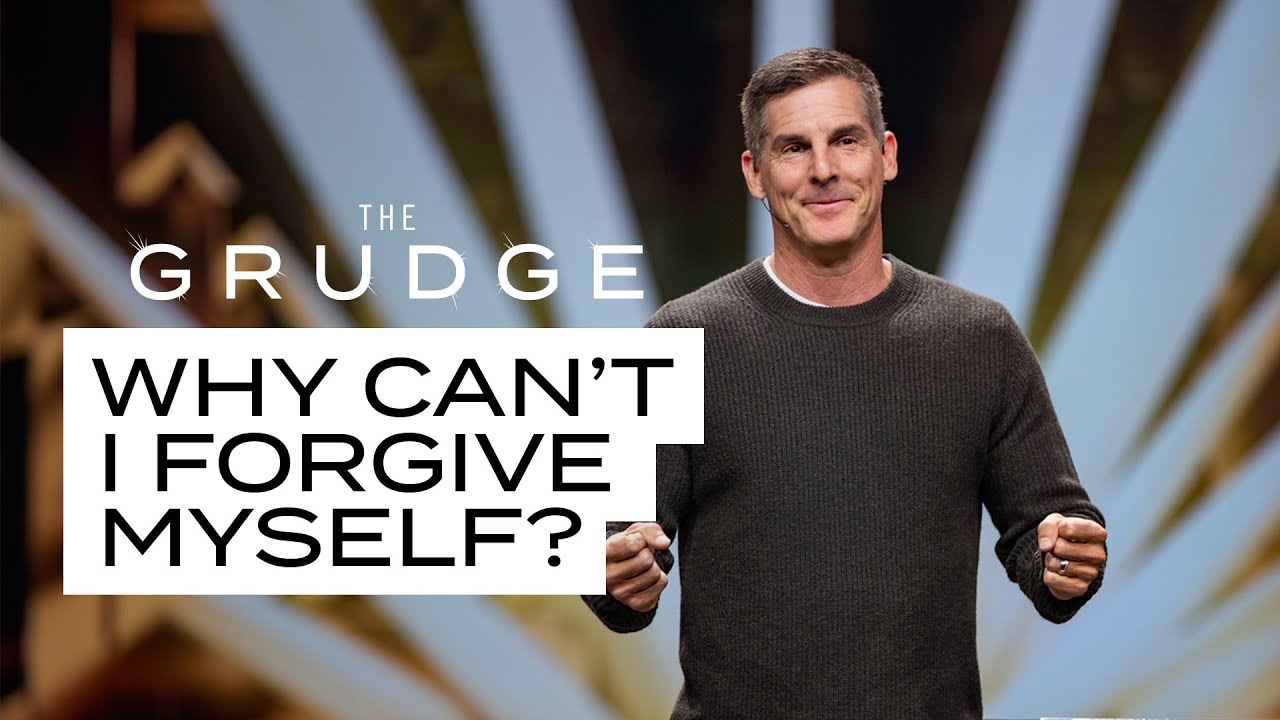
- Why Can't I Forgive Myself?
WHY CAN’T I FORGIVE MYSELF? CRAIG GROESCHEL Hey, I'm so glad to have you with us today at all of our Life.Churches, our churches around the world, and Network Churches, our online family, watching on YouTube, listening on a podcast. If you're new with us, we're in a message series called "The Grudge". We're talking about overcoming offenses and how do we forgive. Week number one, that's what we talked about is how do we overcome the smaller offenses that weigh us down or hold us back. The second week we talked about the bigger betrayals, when someone lies to us or lies about us or deceives us in a significant way. How do we forgive that? Last week we talked about forgiving God. Technically we know God never sins so we don't technically forgive Him but there are people that hold a grudge against God. How do we reconcile with God and make things right? Today I want to talk about forgiving the person that may be the most difficult for many people to forgive and that is forgiving yourself. How do you forgive yourself when you let yourself down or let God down or hurt somebody that you love? When you think about it, this can be so difficult because we know what we did that we shouldn't have done and we wish that we could undo. We know the words that we said, that we didn't really mean. I mean, maybe we kinda meant it at the time but we didn't, it's really not our heart and we said it and now we really hurt somebody. We know what we think about when nobody else is around and we carry the shame. We carry the guilt. How can I forgive myself after what I did or after who I am in this particular situation. This was a real issue for me especially as a new Christian. I was in college, very very far from God and I did a lot of things that hurt a lot of people. And the guilt and the shame of the things that I did, the people that I hurt, it weighed so heavily on me and so I became a follower of Christ and I started to understand the forgiveness of Jesus. Okay, so He forgives me but I couldn't forgive myself. I ended up getting invited to go to this church. It was unlike any church that I'd ever been to. I grew up in a traditional United Methodist Church with pews, hymns, stand up, sit down, do the Apostles' Creed, sit, sing verses one, two and four of every hymn. I don't know what's wrong with verse three but we didn't sing verse three in our church. And this church was way way way different. There weren't hymns. There were people like jumpin' up and down and dancing and lifting their hands up in the air. I'd never seen anything like it and it was bizarre to me, confusing but there was something about it that was also, like wow, these people are into it, this is different. And the pastor preached a message and I'm telling you, I don't know if you've ever had this but it was just like God, him and me and like God was giving him the things to say to me. It was about forgiving yourself. And at the end of the message, he said, If you can't forgive yourself, why don't you come forward to the front? I'd never thought about going forward to the front in a church ever before but without even thinking, it's like I just stood up and started walking forward, thinking I was the only person in that church that was feeling such guilt. Well, little did I know, there were a lot of other people. I just happened to be the first person. I guess I was the guiltiest one and I got up there and there was a line of people and the pastor came to me first because I was the first person there and he just started, you know, the music's playing and there's all these people and I'm cryin' and he said, "Do you feel guilty"? I said, "Yeah, I feel guilty". He said, "Lift up your hands". I'm like, I didn't do this at First Methodist Church but I lifted up my hands and then he did this thing. He said, "You're forgiven" and he stepped forward and he hit my hands really hard. When he hit 'em so hard, I almost fell backwards. Like whoa, fellow, you hit hard. Well, he came in a second time to hit my hands again. I thought, oh, I'm no dummy. We're supposed to high five. And so when he came in to hit my hands again, I stepped into it. I high fived him back. I was ready. He looked at me like I did something wrong. I didn't know. He went to the next person and high fived them and said, "You're forgiven" and they fell to the ground. And the next person fell to the ground. And everybody fell to the ground. First, I felt incredibly guilty for my sin. Then, I felt guilty because I didn't fall to the ground like everybody else. What is wrong with me? Maybe Jesus has forgiven me but how do I forgive myself? I don't know what it might be for you. Maybe you drank too much one night and you did something you can't undo or you said something you can't unsay. Maybe it was years ago you were in your teens or your early 20s and you felt cornered in a very desperate situation. And you made what you thought was the right decision at the time but you have regretted it ever since. Maybe in the name of loving your family you did what you thought was best. You poured yourself into work. I'm gonna be a good provider. I'm gonna be successful for my family. And then years went by and suddenly you're disconnected with your kids and you think, what did I do? Why did I do that? The whole time the most important thing was right in front of me and yet I just poured my life into something else. I can't get over the guilt that I neglected my family. Maybe you found yourself in a really odd spot in your marriage and instead of stepping into your marriage, you stepped out of your marriage. And you did something, betrayed your spouse and you just can't get over the guilt that you feel. Maybe it's the clicking, the looking at things you know you shouldn't look at. And you really do, you love God. And if you're married, you really do love your spouse. But you keep going back and back and back and back again and the shame and the guilt is just overwhelming. What do you do when what you did haunts you? When the guilt just simply won't go away? That's why I've called this message "Why Can't I Forgive Myself"? Why can't I forgive myself? What do you do with the guilt? I want to start today by acknowledging something that I think is very important and that is this. That not all guilt is created equal. Not all guilt is created equal. Some of you are living under what we might call a false guilt. In other words, you're feeling guilty for something you shouldn't feel guilty about. I don't know what it might be for you but maybe you were a kid or a teenager and your parents divorced and you feel like somehow in some way, that was your fault. I should have done something. If I had, my parents, it's all my fault they divorced. That is not your fault. That is a false guilt. Tragically I come across so many people that were victims of someone who abused their power. There might be those of you that someone that you trusted and loved took advantage of you and maybe physically or emotionally in some way they abused you. And so often it's so tragic and so sad but the victim often feels a shame and in some way like I must done something wrong. In some way, it was my fault. It was not your fault. That was not your fault. Don't buy into the devil's game of shaming you with the false guilt. For me, the false guilt that plagued me for years was the loss of my friend that I told you about a few weeks ago. I had a very close friend of mine who ended up in a dark place and when we were not getting along in that season, my friend took his life. And for years this weighed on me. It must have been my fault. If I only hadn't have said that. If I only had done this. What if I had reached out to him? On and on and on the guilt just wouldn't go away. It took help from somebody saying, That is not yours. He mentally wasn't in a good place. Spiritually he wasn't a good place. Emotionally he was out of whack. He made the wrong decision. False guilt is always dangerous, it's always non-productive. It's not from God and we need to let that go. It's a false guilt. Not all guilt is created equal. There's another type of guilt and this guilt can actually, believe it or not, can be a gift when you let it draw you closer to God. The right type of guilt can actually be a gift when it draws you into the presence of God. In fact, 2 Corinthians chapter 7 tells us this. Verse 10 tells us, Godly sorrow, somebody say, godly sorrow. Godly sorrow. Godly sorrow, Scripture says, brings repentance. A sorrow that says I wish I hadn't done that. That wasn't the right thing. I dishonored God, I hurt somebody. I would give anything to not do that over again. That brings repentance that leads to salvation and it leaves no regret. A godly sorrow, it leads to repentance. I'm so so sorry. It brings about salvation and it leaves no regret. But there's another type of guilt or sorrow that's a worldly sorrow and the worldly sorrow brings death. Let's talk the godly sorrow. This is a feeling of conviction. Oh my gosh, I did something that's not right. I am so so sorry. This type of conviction can actually be good and it can be helpful because it can take you off of a wrong path and it can put you onto a right path. This is a godly sorrow that says, you know what, I don't want to live that way anymore. I don't want to be like that. I don't want to say what I said anymore. I want to change directions. I want to change my behavior. I want to apologize. I want to live in freedom. I want to express God's love and heal from what happened in the past. There's a big difference between a godly sorrow and a worldly sorrow. A good example of godly sorrow is Peter in the New Testament. Many of you can probably relate to Peter. I know I can. Peter was a guy that had a lot of good qualities and then he would just do something like stupid on steroids. How many of you can relate to that, okay? You're like, you're going the right direction, you're honoring God, you're doing good things, you're in the zone and then one day, boom, dumber than dumb dumb dumb. Where'd that come from? This was Peter. Unfortunately this can be me. Peter, he's kinda bragging on himself. Jesus, I'm Your guy, man. He walks up to Him, he gives Him the hand, you know, the guy hand to hand, the bro hug. Everybody else denies You, not me, I got Your back. I'm in Your corner. I'll always be there for You. If everyone else lets You down, hey, if You're in a battle, Jesus, You want me in Your army. I will never let You down. And then Jesus kinda sees through his pride and sees his weakness and Jesus said, prophesies, hey, Peter, chill down a little bit because before the rooster crows, you're actually gonna deny Me three times. That's exactly what happens. Jesus gets arrested and a little girl walks up and says, Hey, weren't you the guy that was with Jesus? And Peter's like, Jesus who? I don't know who you're talking about. Another woman comes up to him and says, Hey, weren't you one of the disciples? Weren't you walking with Jesus? And Peter's like, I don't know who you're talking about. I wasn't there. I don't know what you're talking about. I was home doing crossword puzzles or whatever. And then we read in Scripture about a third person that confronts him, Luke 22:59. About an hour later another person asserted, Certainly, speaking of Peter, certainly this fellow was with Jesus, for he's a Galilean. And Peter replied, Man, I don't know what you're talking about. And just as he was speaking, the rooster crowed. Now I'm gonna show you a portion of Scripture that you may not have noticed if you've read through this before. Just at the moment that Peter denied Jesus, Scripture says in verse 61, The Lord turned and looked straight at Peter. The moment that Peter let Jesus down, Peter looked at Him and caught Him straight in the eye and Peter remembered the word the Lord had spoken to him: "Before the rooster crows today, you'll disown Me three times". And Peter went outside and wept bitterly. Wept bitterly. A godly sorrow. I cannot believe I did what I did. I am so so so so so sorry. I was so stupid. Have you ever felt like that? Have you ever felt like that? In the middle of your best intentions, I'll never do that again. And then a short time later, you do it again. I truly love this person with all of my heart. And then in a moment of anger, you say something that you'll regret for years and years to come. You promise yourself that you'll always and then you don't or you never and you do. And then you wake up. I can't believe I did that. Why was I so stupid? How could God love someone like me that never gets it right? That always falls short, that hurts someone I love in such a significant way. The moment you're there, the devil has you exactly where he wants you. The moment you're dwelling in your shame, your spiritual enemy has you in a corner because shame is the devil's playground. Shame is where he wants you. There's a big difference between a godly sorrow, a guilt and a shame that personalizes a behavior. What does guilt say? Guilt says, "I did something bad". I did something that's wrong but it's a separate act. It is forgivable. Guilt said, "I did something bad". Shame says, "I am bad". I am a bad person. And what the devil does is he tries to use your action to connect it with your identity, to create a sense of shame. From this moment forward, the devil wants you to believe you are pathetic. You are worthless. You are useless. God will never use you again after what you thought, after what you said. You'll never be happy. You'll never be blessed. You'll never measure up. You'll never have a real ministry. You'll never have a great marriage. Your kids are never gonna honor you. You're never gonna have a great legacy. You're always gonna be marked by that thing you did because you are bad. The pain you're experiencing, oh, that's just payment for your past. You deserve that. The moment you start dwelling in shame, your spiritual enemy has you exactly where he wants you. You can almost imagine what the devil would have been telling Peter about this time. Peter, you blew it big time. Jesus trusted you. Jesus, out of all the people in the world, Jesus selected you, Peter, to be one of His disciples and then you went off, bragging about how great you were. You'd be there for Him, and then you let Him down. You betrayed Him. You fell short. And to get, just top it off, Jesus saw you do it. He looked you right in the eye. Guess what, Peter? All the disciples are gonna know about it. You're never gonna have any credibility again. Your life is over, your integrity is shot, your ministry is ruined. Peter, you completely, look, you should be so ashamed of yourself. Shame is the devil's playground. What does your spiritual enemy want to do? The devil wants to use your shame to drive you away from God. You're not good enough for God. You'll never measure up. After what you did, after the way you think, after the way you behave, after what you said, God could never really love you. The devil wants to use your shame to drive you away from God. But God wants to use your guilt to draw you to His grace. Come on, somebody, can you feel that the power that the godly sorrow says, I don't want that anymore. I have a safe place to turn. I have a God who loves me, a God who still cares about me, a God who receives me. His mercies are new every single morning. The devil wants to use your shame to drive you away from God. You'll never be successful. You'll never be fulfilled. You'll never have anything significant or meaningful in your life. But our God is goodness. He wants to use a godly sorrow, a healthy guilt to draw you to His grace so you receive His mercy and you're free to do His will. Think about this. It's very similar to comparing what Peter did and what Judas did. They essentially did the same thing. If you don't know Judas' story, just like Peter, Peter denied Jesus three times. Well, Judas betrayed Him one time for 30 pieces of silver. And instead of having a godly sorrow, Judas had what many of us have. In his shame, he had a worldly sorrow. I'm so busted. My life is over. I got caught. I'm so embarrassed. I'm so ashamed. I can never face anyone again. And so what did Judas do? In his shame, he separated himself from God and he took his own life. Shame is the devil's playground. Then there was Peter who essentially did something very similar to Judas but instead he had a godly sorrow, a godly sorrow. I'm so sad that I did this. I was wrong. Would You forgive me? And godly sorrow leads to repentance. Repentance. What is repentance? Repentance is simply changing directions. Re-means to turn, pent is kind of like a penthouse. It's turning from a lower way to turning to a higher and a better way. It's simply turning. God, I'm so sorry. I don't want to ever live like that again. I don't want to talk like that again. I don't want to treat someone like that again. I want to live in Your ways. I want to find freedom. I want to be a blessing. I want to be a voice of hope. It's a godly sorrow that leads to repentance. I acknowledge that I sinned. God, I'm so sorry. I'm not making any excuses for what I did or what I didn't do. It's a godly sorrow that leads to repentance. Jesus went on to give His life. Why? For the forgiveness of our sins. The One who was perfect became sin for us on a cross. He died in our place and the world went dark. Three days later, when some women went to the tomb to check on things, the stone was rolled away. The tomb was empty. The Son of God, Jesus, was not there but God had raised Him from the dead so that we can be forgiven. So we can experience His grace. In John's gospel, chapter 21, you can read this powerful story. Jesus shows up to Peter, the one who failed three times and failed and denied Jesus in front of Jesus' eyes. And Jesus looked at Peter and He said, Peter, do you love Me? And Peter's like, Yes, I love You. I did love You, I do love You. I just did something stupid. Isn't that the way it is sometimes? Yes, I love You. Yes, I want to do what's right. Yes, I messed up. I don't know why but I just did. Yes, I love You. And let me tell you what Jesus did not say. He didn't say, I told you you were gonna do it. Didn't say that. He didn't say, I want you to dwell on your past. Think about it. You're in spiritual time-out. He didn't do that. He didn't say, You need to wallow in your sin for a while. You need to drown in your guilt because you now are going to hell where the worm never dies. This is my bad Southern preacher. Where the worm never dies. And there's weepin' and gnashin' of teeth. He didn't do that. No no no no no no no. Feel the power, feel the love. Peter, do you love Me? Jesus, You know I do. And I can imagine Jesus smiling, saying, Then feed My sheep. In other words, then do My will. Go show My love. Finish your assignment. Do you love Me? Yes, I do. You're forgiven. Go do what I created you to do. Let me tell you what Peter didn't do. Peter didn't say, I just can't receive Your grace. I'll never get over it. I don't deserve it. Jesus, Your grace may be enough for John, but Your grace isn't enough for me. Peter didn't do that. But that's exactly what many of us do. You can't really forgive me. I deserve to live in shame for the rest of my life. No. He acknowledged his sin. He apologized. He repented. He received the forgiveness of Jesus. I don't know what you're holding. Something you didn't do years ago that you should have done. Something that you did that still weighs on you. Something you said. Something in a moment of stupidity. If you've confessed that to Jesus, it is forgiven and it is time for you to let it go. To let it go. For those of you that are afraid I'm gonna break into a Disney song, it's not gonna happen. I raised six kids. I never want to hear that song again as long as I live. But I'll preach it in a sermon. Let it go. Let it go. God's Word says this in 1 John 1:9 that if we, listen to me, if we confess our sins to God, listen, our God is faithful and He is just. Watch. To forgive us our sins and to purify us from all unrighteousness. All unrighteousness. All unrighteousness. Let it go. Let it go. If you've taken it before God, Jesus has covered it. God doesn't hold it against you. He has forgotten your sin. You're free. Don't let the pain of the past rob you from God's calling for your future. Let it go. Let it go. The neglect. The lies. The words that you said. The thoughts that you had. Let it go. Because you need to acknowledge the truth no matter what you do. No matter how hard you try, no matter how much you will it or how much you want it, you cannot change your past. But the good news is, our God can change your future. Let it go. Let it go. Let it go. You did something that you wish you hadn't done, let it go. You betrayed someone, let it go and spend the rest of your life being faithful. You got hooked early on something you wish you weren't hooked on, but you're free now. Live and walk in freedom and help others find that same freedom. Do you love Him? Yes. Then go do His will. Feed His sheep. Let it go. Maybe you let God down, you let yourself down, you let somebody else down. If it's covered by the blood of Jesus, don't live in the past. Let it go, whatever it is. You smoked something last night, you slept with someone last night, let it go. Let it go. Here's what's gonna happen though, and be warned. Your spiritual enemy is sly. Every now and then, he'll try to bring up your past. Well, you did this and you thought that and you said that and you weren't there for them and you let them down and you can never undo that. Anytime the devil brings up your past, just remind yourself he's bringing up your past because he's intimidated by your future. God's hand is still on you. His grace is still in you. His power still works through you. Just remind yourself, your enemy's trying to talk you out of God's potential for your life. Think about Peter. This means so much to me. Who did God choose to be the guest speaker at Pentecost when God poured out His Spirit? God chose Peter. And what was Peter's message? It was very very simple and it was unbelievably powerful. Peter said, Repent of your sins. Just turn away from it. Call on the name of Jesus and you'll be saved. You will be forgiven. Think about who God chose to do His will, to preach His truth, to lead people to grace. He didn't choose the one who was perfect. He chose the one who was forgiven. He didn't choose the one who was always faithful. He chose the one who experienced grace. If you've been forgiven of much, guess what? You can love so much more. Do you love Him? Feed His sheep. Do His will. You are not what you did. That's something that you did. That's not who you are. The devil wants you to connect action to identity. You did something bad. The devil wants you to think you'll always be someone bad. But Jesus makes all things new. It's what I did, not who I am. I am a child of God. Yup, that was a bad page in the book. That was a bad chapter in my life. But my story is not over yet. God is still writing my story and I am confident of this, Paul said. You can be confident of this. That He who began a good work in you will be faithful to carry it out until completion until the day of Christ Jesus. Whatever it is, the weight, the guilt, the shame, take it to the One who died for it. Confess it. Turn from it and find freedom. Let it go. Father, we ask in the name of Your Son, Jesus, that You would do spiritual surgery, God, on hearts today. As you pray and reflect at all of our campuses, those of you that you are Christians, you are committed to follow Christ, but you still feel the weight of something you did or didn't do, said or shouldn't have said and you want to find the freedom from that. You want to help letting it go, would you lift up your hands right now, just all of our churches, just hands going up all over the place. God, thank You that today's the day of freedom. That whoever the Son sets free, God, we know is free indeed. And I pray, God, today for a miracle in hearts that we would step out of shame and into Your grace. Out of guilt, God, into Your freedom. That we'd recognize this is actually a godly sorrow that leads to repentance, a new direction that brings salvation and brings life. God, for whoever is living in the shame of the past, God, help us step out of that shame and into Your grace, receiving Your forgiveness, God, and letting it go to do Your will. God, by the power of the One that You raised from the dead, help us to let it go. As You have forgiven us, God, so we receive Your forgiveness and we forgive ourselves. Let it go. Your sin is forgiven. God remembers it no more. You are free from the past to do God's will in the future. Let it go. Let it go. As you keep praying today at all of our churches, nobody looking around, just reflecting on this, there are those of you, you're gonna say, if we had a honest conversation, you might say, you don't really know where you stand with God. You really may feel the weight and the guilt of the past. This was me for years and years and years. I thought I had to be really really good, do lots of good things to make up for all the bad things and stop doing all the bad things. Then I realized the harder I tried, I just never could quite stop. I didn't understand the grace of God. Who is Jesus? Jesus is the Son of God who was perfect in every way. He never ever sinned. That's why He was the perfect sacrifice for our sins. He became sin on the cross. He died in our place. His death was a substitutionary death. He died so we don't have to die. He paid the price. God raised Him from the dead, proving that death, hell it's been conquered, that Jesus is risen, He is Lord and anyone who calls on the name of Jesus, doesn't matter what you've done, doesn't matter how dark your life is, anyone who calls on the name of Jesus, your sins would be forgiven, you would be saved. The old would be gone and everything would become new. In fact, there are those of you, maybe you're watching on YouTube or listening to a podcast or you're watching online or you're in a campus right now and you recognize you don't know where you stand with God. You're not watching by accident. You are here at this moment at this time because of the goodness and the grace of God. He's drawing you right now. And when you pray, when you call on Him, when you repent of your sins, He hears your prayers. He forgives your sins. He separates them as far from you as the east is from the west and you become spiritually new. At all of our churches today, those who say yes, I want His grace, I want His forgiveness, I simply turn, I turn from my sin, I turn toward Jesus. Today I give my life to Him. If that's your prayer, lift your hands high now, all over the place, lift them up now. Say yes, that's my prayer. Right back over here, and up here in this section, right up here. Three of you up here, praise God for you. Others of you today. Right up here, praise God for you, and here as well. Two hands right back over here. Come on, somebody. Can we give our God some praise? Right back over here. Church Online, you click right below me. Here in the middle section, my gosh, right back over here. Can somebody give God some praise today? If you're able, church, would you just stand to your feet in honor of those that are coming to faith in Christ? When we pray, we don't pray alone. We are family. Would you join your faith with those around you and pray this prayer aloud? Heavenly Father, forgive all my sins. Jesus, save me. Change me Make me new. Fill me with Your Spirit, so I can know You, so I can walk in Your ways, so I can do Your will on earth as it is in heaven. Thank You for Your grace. Thank You for new life. My life is not my own, I give it all to You. In Jesus' name I pray. Forgiving others is hard, but forgiving yourself can be even more difficult. When guilt and regret fill your past, believing in your future seems impossible. But God wants you to step out of the shame that holds you back and into the freedom He has for you. Join Pastor Craig Groeschel and see how much your future can change when you choose to forgive yourself. www.lifechurch.tv/open .
- Why Don't Single Men Go to Church?
The way we raised boys in the faith 20 years ago eliminated many of the men Christian women would love to date today. Ladies, I feel your pain. The dating scene in the church is grim. Christian colleges are becoming convents. Churches all over the world report a shortage of men in the pews – and it seems to be getting worse. What about the singles’ group at church? One woman put it this way: “Well, about two-thirds of the singles [at my church] are women, and the men who come are kinda wimpy. Or creepy. There’s a reason they’re single.” So I’ll ask the question you’ve probably asked a thousand times: Where are all the dynamic, single godly men? Simple. We screened them out of the church as boys. Picked ’em off one by one. The way we raised boys in the faith 20 years ago eliminated the very kinds of men some women would love to be dating today. What Happened? There are only two possible explanations for the lack of men in church – either A) men are more sinful than women, or B) there’s something about the church that’s driving men away. The more I study men and church, the more I’m convinced “B” is the more likely cause. Metaphor time: you’re standing in an asphalt plant. The operator loads pebbles of every size into a hopper. The pebbles are shaken through a series of screens that remove every stone that’s either too large or too small. The resulting gravel mix is perfectly suited to road surfacing. Now, let’s apply that metaphor to the local church. Children of every kind come into the hopper. They are screened through children’s ministry and youth ministry. These programs remove the ones who are poorly suited to church culture. The final mix of adult churchgoers is heavily female and very short on high-testosterone men. But it’s perfect for perpetuating the church culture we presently know. Screen 1: Sunday School Little boys love going to church. There’s no shortage of lads in nurseries, Vacation Bible School and the lower grades of Sunday school. But around the fourth or fifth grade, boys start disappearing, because that’s the age when males begin losing in church. Losing in church? You didn’t realize church was a competition, did you? Well, with boys everything is a competition. And it’s a contest most boys can’t win. The rules of Sunday school are stacked against them: sit still, read aloud, memorize, find passages in the Bible and receive instruction from a female teacher. With rules like these, who’s more likely to win? Girls or boys? By age 12, many boys have been losing in church every Sunday for years. Females possess superior verbal skills, reading skills and finger dexterity (for finding Bible passages). They can sit still longer and instinctively know how to express themselves in small groups. The average girl is made for Sunday school, whereas the average boy is made for the soccer field. And that’s where increasing numbers of young men can be found on Sundays – kicking a ball, doing something they’re good at. Many of the dropouts are the wiggly, high-testosterone boys who grow up to become leaders, athletes and alpha males. The kind of men many women would love to be dating right now – if only there were more of them following Jesus. Of course some boys do make it through Sunday school, where they encounter the next screen: youth group. Screen 2: Youth Group When I was an adolescent, youth group was fun. It was based on the three Gs: Games, Goofiness and God. We sang simple songs. We played nutty games. The teaching time was brief but meaningful to teens. I loved it. And it attracted a lot of guys. Church services were sometimes boring, but youth group was always a kick. Youth leaders of the 1970s were almost always men – that big brother role model the boys craved and the girls looked up to (and had secret crushes on). Fun and games are still a part of youth group, but there’s been pressure to make it more “spiritual” by increasing the amount of time devoted to teaching. Singing time has also increased. And today many youth groups are led by young women. These three trends are screening boys out. Let’s take them in reverse order: Female youth leaders. Here’s the politically incorrect truth about teenage boys: Most young men will not follow a woman’s leadership. There is no example in Scripture of a woman discipling a young man. And women bring a different style to youth group – more emotive, more introspective and more focused on feelings. I’m not saying it’s impossible for a woman to minister to teenage boys, but she’s at a disadvantage. Lengthy worship sets. Praise and worship arrived in youth group during the early 1990s. The goofy songs disappeared. Singing time expanded to 30 minutes or more. The whole feeling changed from a fun group activity to an intimate personal time with God. The youth meeting is quickly evolving into a music-centric experience. Teens stand in a darkened room and sing love songs to Jesus, led by a praise band of their peers. Girls thrive in this emotional hothouse, but boys melt and evaporate. Many guys stand in the crowd with their hands in their pockets thinking, This is lame. Or, I’m supposed to like this, but I don’t. What’s wrong with me? Before you know it, you’ve got 19 girls and five guys at youth group. And there’s not a jock among the guys. Teaching. Youth leaders have come under intense pressure to focus most of their teaching on sexual purity and relationships — often at the expense of other topics. The pressure is coming from frightened parents who see it as the youth leader’s duty to get their children through high school without a pregnancy or an STD. This focus on sexual purity has morphed into a number of peculiar teachings that alter the dating habits of young Christians – and drive young men out of the church. The anti-dating movement. Inspired by the bestselling book by Joshua Harris, many young believers have decided to kiss dating goodbye. Instead, they plan to someday enter into formal courtship arrangements with potential mates, preferably under parental supervision, with an eye toward marriage. I’m not speaking against this practice, but you can see how it might feel like a straightjacket to a young man. A nice fellow may be seen as a wolf simply for asking a girl on a date. The super-virginity movement. I know a number of Christian couples who not only refused to have sex before marriage, they have shunned all physical contact. No kissing. No hugging. Some even declined to hold hands before their nuptials. The goal was to have their first kiss at the altar, as they are pronounced man and wife. Once again, I’m not condemning the practice. But supervirginity requires the marrying man to take an enormous risk. During courtship, the supervirgin couple explores their spiritual, mental and emotional compatibility, but may not know if there’s a spark of physical passion between them. The supervirgin woman enters marriage knowing exactly how her husband will respond mentally and emotionally (her primary needs), but the supervirgin man has no idea how she will respond physically (his primary need). Kissing, hugging and handholding are good indicators of physical chemistry; take these away and a guy has no clue whether he’s marrying a red-hot tiger or a cold fish. Of course, these things shouldn’t really matter, because of a third peculiar teaching that’s rampant in the church today: God has prepared one special person for you to marry. That’s right: Jesus is our heavenly matchmaker. You don’t need to actively search for a mate; simply pray and God will plop that perfect person down in front of you one day. This crazy teaching has its genesis in Genesis — the only two occasions in Scripture where God provided a specific wife for a specific man. God gave Eve to Adam and provided Rebekah for Isaac. Both were special cases: Eve was the mother of the human race, and Rebekah was the mother of the Hebrew nation. Through the remaining 65 books of the Bible, God never arranges another marriage. Nonetheless, youth leaders the world over point to these two ancestral couples as proof that God preordains a special mate for each of us. This bad snippet of theology causes all kinds of dysfunction among young Christians. They fall in love and then pray intently: “God, is this the one You have prepared for me?” God is silent. Hearing nothing, they have two choices: walk away from a perfectly acceptable mate or marry under a cloud of fear, terrified that they’re outside of God’s will. A man can choose a Christian girlfriend with all her fantasies and prohibitions, or he can choose a regular girlfriend who will pucker up. Increasingly, even Christian men are choosing to date outside the church. It may not be right; it’s just easier. Who’s Left The single men who survive the screening process generally fit one of the following profiles: The Bible geeks. Quiet, studious men who love to study theological tomes. Or verbal guys who love to teach. The musical. They play in the band. Or they stand on the front row raising their hands during the music. The asexual. Guys who are OK with kissing dating (and kissing) goodbye. The predators. Guys who know there are plenty of desperate young women in church and enjoy trying to get them in bed. The social misfits. Strange men who come to church because it’s the only place women will smile at them. If you’re into these kinds of guys, then the church dating scene isn’t so bad. If not, then you’ll have to fight over the most rare (and for some, the most desirable) category of single churchgoing men: the late converts. These are men who came to Christ in their teens or 20s, bypassing much of the screening process. Many were saved out of terrible sin. They have been forgiven much and love God much. (These guys get snapped up quickly by the best-looking women.) Where Does That Leave Us? By their senior year, girls are 14 percent more likely to have participated in a youth group than boys. And they are 21 percent more likely to have stayed involved in youth group all four years of high school. Congratulations. The stage is set for the female-dominated church of the future. So what’s the answer? We need a revolution in how we raise boys in the faith. Sunday school and youth group are screening out men years before they reach adulthood. Christians must have the courage to change these institutions so regular, red-blooded boys are more likely to grow up in church. I’m not saying we should pander to men, but would it be too much to accommodate them? Want some good news? The changes are possible! www.churchesformen.com .
- How to Be SURE God Will Answer Your Prayer!
John Piper teaches a powerful lesson on God’s conditions for answering your prayers. Here’s how to pray more powerfully! “God never ignores his children. He is never too busy. Never lacking in resources. Never confused. Never ill-disposed. He is always attentive. Always gracious. Always eager. Always wise. Always loving. He hears every request from his humble, trusting children, and he answers with whatever is best. It always pays to pray. Always. That does not mean a life of prayer is not perplexing. My aim is to encourage you in your prayers by answering three especially difficult questions: (1) What does it mean to ask God for things “according to his will” ( 1 John 5:14 )? (2) Why are we not told to pray for the forgiveness of “sin that leads to death” ( 1 John 5:16 )? (3) What does “whatever” mean in 1 John 3:22 , when it says, “ Whatever we ask we receive from him, because we keep his commandments and do what pleases him”? I think a text-based answer to each of these questions is a great encouragement to pray. I focus on these three questions because, in trying to answer the first one, I realized that the context led to answers for the other two as well. Here is the text that raises, and answers, the first two questions: This is the confidence that we have toward him, that if we ask anything according to his will he hears us. And if we know that he hears us in whatever we ask, we know that we have the requests that we have asked of him. If anyone sees his brother committing a sin not leading to death, he shall ask, and God will give him life — to those who commit sins that do not lead to death. There is sin that leads to death; I do not say that one should pray for that. All wrongdoing is sin, but there is sin that does not lead to death. We know that everyone who has been born of God does not keep on sinning, but he who was born of God protects him, and the evil one does not touch him. ( 1 John 5:14–18 ) Two Wills in God What does “according to his will” mean in verse 14? “If we ask anything according to his will he hears us.” There are two possible meanings for “God’s will” found in the Bible. On the one hand, God’s will is what he commands, or what he tells us is right to do. On the other hand, God’s will is whatever God decides will come to pass. We can call the first meaning God’s will of command . And the second we can call God’s will of decree . For example, you can see God’s will of decree in Ephesians 1:11 : “[God] works all things according to the counsel of his will.” Or in James 4:15 : “If the Lord wills, we will live and do this or that.” In both of these texts, the will of God refers to God’s control over all that happens: “All things.” Staying alive and doing “this or that.” This is God’s will of decree. Everything that happens is God’s will in this sense. “Our God is in the heavens; he does all that he pleases ” ( Psalm 115:3 ; cf. Psalm 135:6 ). On the other hand, you can see God’s will of command , for example, in 1 John 2:17 : “Whoever does the will of God abides forever.” Or Mark 3:35 : “Whoever does the will of God, he is my brother and sister and mother.” Or 1 Thessalonians 4:3 : “This is the will of God, your sanctification.” We can see that “will of God,” in these verses, does not mean “all that happens.” It refers to what God commands as right for us to do. The fact that there are two biblical ways to speak of “God’s will” means that a single act might be God’s will in one sense, but not in another. For example, it was clearly sinful and contrary to God’s will of command that innocent men would be crucified. God commanded, “You shall not murder” ( Exodus 20:13 ). But men murdered Jesus, according to God’s plan of redemption. Isaiah 53:10 says, “It was the will of the Lord to crush him; he has put him to grief.” And Acts 4:28 says that these murderers (Herod, Pilate, Gentiles, Jewish crowds) did “whatever [God’s] hand and [God’s] plan had predestined to take place.” So the killing of Jesus was God’s will in the sense of his will of decree, but not his will in the sense of his will of command. Now, which of these is intended when John writes, “If we ask anything according to his will he hears us” ( 1 John 5:14 )? Do Born-Again People Sin? The answer is found as we keep reading in verse 16: If anyone sees his brother committing . . . sin not leading to death, he shall ask, and God will give him life — to those who commit sins that do not lead to death. There is sin that leads to death; I do not say that one should pray for that. This concern with “sin that leads to death” and “sin not leading to death” is part of John’s larger concern in this letter. From beginning to end, John is concerned to guard against two opposite errors: (1) treating ongoing sin lightly and (2) despairing that if a believer sins he is lost. Both are errors. Some of John’s community seem to think that you can continue sinning and still be born again. Others seem to think that, if you are born again, you don’t have any sin in your life. To the first group, John says, “No one born of God makes a practice of sinning” ( 1 John 3:9 ). To the second group, he says, “If we say we have no sin, we deceive ourselves” ( 1 John 1:8 ). In other words, Christians sin, but Christians do not settle in with the practice of sin. Born-again people confess their sin as abhorrent ( 1 John 1:9 ), and make war on their temptations ( Romans 8:13 ). Sin That Leads to Death So when we come to 1 John 5:16 and read about two kinds of sinning, we should not be surprised. One kind “leads to death.” And the other kind does “not lead to death.” John is not referring to a particular sin. What, then, is he referring to when he says, “there is sin [not a sin] that leads to death”? Verse 18 gives the clue. Right after saying, “There is sin that leads to death” (v. 16) and “there is sin that does not lead to death” (v. 17), John says, We know that everyone who has been born of God does not keep on sinning, but he who was born of God [Jesus] protects him, and the evil one does not touch him. ( 1 John 5:18 ) So the sinning that does not lead to death is the sinning of those who are “born of God,” but whose sinning is restrained by Jesus. Jesus protects and keeps his own. He restrains their sinning. He does not make them perfect in this life. But neither does he leave them to the power of sin. He protects them. And the evil one does not touch them in the sense of bringing them to ruin. This implies, then, that “sin that leads to death” is the sinning of those who are not born of God. Their sinning is not restrained by Jesus. In fact, they are not true believers. They may be part of the church for a time, but they give way to patterns of sin and fall away. John describes them in 1 John 2:19 : They went out from us, but they were not of us; for if they had been of us, they would have continued with us. But they went out, that it might become plain that they all are not of us. The reason I say they are not true believers is that John says, “Everyone who believes that Jesus is the Christ has been born of God” ( 1 John 5:1 ). In other words, saving faith is a sign that one has been born of God, and we just saw in 5:18 that those who are born of God are kept by Jesus. He does not let them go on sinning — that is, he keeps them back from “sin that leads to death.”So I am concluding from 1 John 5:18 , and the wider context of 1 John, that “sin that leads to death” is not a particular sin, but a pattern of unrestrained sin that leads one away from Christ, and shows that one was never born again ( 1 John 2:19 ; 5:1 , 18 ). It “leads to death,” therefore, in the sense that it leads to destruction. Final ruin. Hell. ‘I Do Not Say to Pray for That’ Now we are in a position to circle back and see how verse 16 (“There is sin that leads to death; I do not say that one should pray for that”) sheds light on the meaning of verse 14 (“If we ask anything according to his will he hears us”). Does verse 14 refer to God’s will of decree, or to his will of command? To answer this, we should ask why John writes, “I do not say that one should pray for [the sin that leads to death].” The reason is that there is no point in it. The prayer would be for repentance and forgiveness and life (as in v. 16a). But John has made clear that this sinning leads to death. There will be no life. That’s the whole point of saying there is sin that leads to death. If one could pray successfully for life, the sin would not be sin that leads to death. Now here’s the implication for the meaning of praying “according to [God’s] will.” It is clearly God’s will of command that we pray for sinners that they would repent and be saved. Paul said, “Brothers, my heart’s desire and prayer to God for them is that they may be saved” ( Romans 10:1 ) — including those who are “accursed and cut off from Christ” ( Romans 9:3 ). And he prayed for believers, that they would be “kept blameless at the coming of our Lord Jesus Christ” ( 1 Thessalonians 5:23 ). So, if it is “according to [God’s] will” that we pray for straying people, why does John say, “I do not say that one should pray for [the sin that leads to death]”? The answer is because God does not intend to save them. They have crossed a line. They are like Esau in Hebrews 12:17 , who had sinned in such a way that he could not repent and find forgiveness. In other words, it is not God’s will to save those who have sinned in a way that “leads to death.” He will not grant repentance. His will of decree is to let them go. No praying will change it. According to God’s Will of Decree But why does John not come right out and say, “Do not pray for that,” instead of saying, “I do not say that one should pray for that”? It’s because he does not assume we can always know who these people are. To command us not to pray for them would imply we can always recognize them. But we can’t. We can’t always tell when someone has sinned to the point of being beyond repentance. So John only says that praying for them would be ineffectual. God has willed to leave them alone. “I do not say that one should pray for that.” Which means that if you ask for their repentance and forgiveness, you will not get it. But verses 14–15 say, “If we ask anything according to his will . . . we have the request.” Therefore, I do not take “according to his will” to mean “according to his will [of command],” because, as we’ve seen, it is according to his will of command that we should always pray for straying saints and unbelievers. Rather, I take “according to his will” in verse 14 to mean “according to his will [of decree],” because verse 16 shows that God has decreed not to save these people. So you need not pray for them, and if you do, you will not receive what you ask. It doesn’t accord with God’s will of decree. So when John says, “If we ask anything according to his will he hears us” ( 1 John 5:14 ), he means, “If we ask anything that accords with God’s all-wise plan — his all-wise decrees for the world — he hears us and grants our request.” The reason I say they are not true believers is that John says, “Everyone who believes that Jesus is the Christ has been born of God” ( 1 John 5:1 ). In other words, saving faith is a sign that one has been born of God, and we just saw in 5:18 that those who are born of God are kept by Jesus. He does not let them go on sinning — that is, he keeps them back from “sin that leads to death.” So I am concluding from 1 John 5:18 , and the wider context of 1 John, that “sin that leads to death” is not a particular sin, but a pattern of unrestrained sin that leads one away from Christ, and shows that one was never born again ( 1 John 2:19 ; 5:1 , 18 ). It “leads to death,” therefore, in the sense that it leads to destruction. Final ruin. Hell. So , if it is “according to [God’s] will” that we pray for straying people, why does John say, “I do not say that one should pray for [the sin that leads to death]”? The answer is because God does not intend to save them. They have crossed a line. They are like Esau in Hebrews 12:17 , who had sinned in such a way that he could not repent and find forgiveness. In other words, it is not God’s will to save those who have sinned in a way that “leads to death.” He will not grant repentance. His will of decree is to let them go. No praying will change it. This Does Not Make Prayer Pointless A common response to this conclusion is that it seems to make prayer pointless, because answered prayer happens only when God has decreed that something be done. Wouldn’t the decreed event happen anyway? So why pray? But that kind of response does not come from careful biblical thinking. Careful thinking would see that God really does things in response to prayer. “You do not have, because you do not ask” ( James 4:2 ). God wills that events be caused by prayer. And careful biblical thinking would also see that, just as God decrees effects, he also decrees the causes of those effects. As he decrees ends, so he decrees means. As he decrees that a straying saint repent and return, so he decrees the prayers that bring him back. Prayer is a real cause of real events in this world. God has willed it to be so. And so it is. Because We Do What Pleases Him’ Now what about our third question? What does “whatever” mean in 1 John 3:22 when it says, “Whatever we ask we receive from him, because we keep his commandments and do what pleases him”? The answer is connected to what we have seen. A different condition is laid down for answered prayer here in 3:22 than was laid down in 5:14. There the condition was that the answer to prayer comes, if we pray according to God’s will — according to God’s all-wise plan, his will of decree. Here the condition is that the answer to prayer comes, if we “keep his commandments and do what pleases him.” How do these two conditions go together? What Pleases God Is Glad Submission to His Sovereignty Here is my suggestion. The condition of 3:22 includes the condition of 5:14. That is, doing what pleases God includes consciously and gladly submitting to God’s will of decree. This decree will always be the wisest and most loving response to our prayers. John says that whatever we ask we receive, if we “do what pleases [God].” What does please God? When it comes specifically to prayer, at least these three things: According to 1 Peter 5:6 , it pleases God if we are humble before God: “Humble yourselves under the mighty hand of God.” So it pleases God when we gladly admit we are not God. We are in no condition to run the world, or to take the reins of the universe out of God’s hands. According to James 3:2 , “We all stumble in many ways. And if anyone does not stumble in what he says, he is a perfect man.” It pleases God for us to admit this. And the words “what he says” include “what he says in prayer.” We don’t suddenly become perfect when we pray. We are finite and fallible. We make mistakes. God is pleased when his people admit this. According to James 4:15 , Christians “ought to say, ‘If the Lord wills, we will live and do this or that.’” We ought to say this. That is, it is pleasing to God, when we actually say (in prayer!), “If the Lord wills, we will live and do this or that!”From these three biblical descriptions of what pleases God when we pray, it seems to me that the condition we must meet, according to 1 John 3:22 , in order to receive what we pray for, includes the condition we must meet in 1 John 5:14 . The condition there was this: “If we ask anything according to his will [of decree] he hears us.” I’m suggesting that implicit in this condition is the God-pleasing disposition to embrace God’s decreed responses with confidence that they are best. In other words, what pleases God is a humble mind that confesses our finiteness and fallibility, and says, “If the Lord wills, the people we pray for ‘will live and do this or that.’” God never ignores his children. He is never too busy. Never lacking in resources. Never confused. Never ill-disposed. He is always attentive. Always gracious. Always eager. Always wise. Always loving. He hears every request from his humble, trusting children, and he answers with whatever is best. It always pays to pray. Always. That does not mean a life of prayer is not perplexing. My aim is to encourage you in your prayers by answering three especially difficult questions: (1) What does it mean to ask God for things “according to his will” ( 1 John 5:14 )? (2) Why are we not told to pray for the forgiveness of “sin that leads to death” ( 1 John 5:16 )? (3) What does “whatever” mean in 1 John 3:22 , when it says, “Whatever we ask we receive from him, because we keep his commandments and do what pleases him”? I think a text-based answer to each of these questions is a great encouragement to pray. I focus on these three questions because, in trying to answer the first one, I realized that the context led to answers for the other two as well. Here is the text that raises, and answers, the first two questions: This is the confidence that we have toward him, that if we ask anything according to his will he hears us. And if we know that he hears us in whatever we ask, we know that we have the requests that we have asked of him. If anyone sees his brother committing a sin not leading to death, he shall ask, and God will give him life — to those who commit sins that do not lead to death. There is sin that leads to death; I do not say that one should pray for that. All wrongdoing is sin, but there is sin that does not lead to death. We know that everyone who has been born of God does not keep on sinning, but he who was born of God protects him, and the evil one does not touch him. ( 1 John 5:14–18 ) ‘Whatever’ Is Best for Us What then is the answer to our third question — the meaning of “whatever” in ( 1 John 3:22 )? “Whatever we ask we receive from him, because we keep his commandments and do what pleases him.” The meaning of “whatever” is shaped by the all-wise, all-encompassing, loving plan of God for the good of his children and the glory of his name. By “shaped” I mean limited or expanded, hastened or delayed, purified and completed, but never ignored. If we ask for bread, he will not give us a stone, but he may give us cake, or cornbread, or cod liver oil. If we ask for a fish, he will not give us a snake, but he may give us steak, or stew, or lutefisk ( Matthew 7:9–11 ). He is our Father. His resources are infinite. His love is perfect. His wisdom is unsearchable. He is never at a loss. Therefore, he will only give us whatever is good for us ( Romans 8:28 , 32 ; Matthew 6:33 ). That is what I think “whatever” in 1 John 3:22 means. So, be encouraged to pray. Set yourself to please the Lord in all humility, admitting your fallibility, and submitting to his perfect plan and his all-wise decrees. He has decreed millions of things to do in answer to prayer. Our prayers are real causes of the events God planned — just as much as flipping a light switch is a real cause of light in the room, or turning a faucet handle is a real cause of water in the sink, or swinging a hammer is a real cause of a well-sunk nail. It is absolutely true that we “do not have, because [we] do not ask” ( James 4:2 ). So, ask. Keep God’s word. Do what pleases him. And ask. Of course there are things he will not do. That was the point of 1 John 5:16 . He does not forbid us to pray for those, because we cannot always know what they are. But he does tell us that only his wise decrees will come to pass. And he calls us to please him by being humbly submissive to his sovereignty in what he brings to pass. Therefore, it always pays to pray. Always.” www.desiringgod.org .
- God's Secret Strategy for Success
Long before Jesus took on the imagery of the vineyard for Himself, God had been using vineyard imagery to communicate His heart to the people. The Song of Vineyard is nestled in Isaiah 5:1-7. This delicate yet ferocious poem provides the most detailed description of caring for vineyards in the Scripture. The syllables capture… God’s tender care God’s intimate involvement God’s long-term commitment God’s meticulousness God’s attentiveness God’s treasure God’s fierce love God’s hot jealousy Watch as a startling turn of events unfold … “I’ll sing a ballad to the one I love, a love ballad about his vineyard: The one I love had a vineyard, a fine, well-placed vineyard. He hoed the soil and pulled the weeds, and planted the very best vines. He built a lookout, built a winepress, a vineyard to be proud of. He looked for a vintage yield of grapes, but for all his pains he got junk grapes.” Read more.... I AM the vine. Long before Jesus took on the imagery of the vineyard for Himself, God had been using vineyard imagery to communicate His heart to the people. This vintner breathes passion about his vineyard. For him, shortcuts are not an option. Rather than use inferior seeds, he invests in shoots from world-class vines that will yield the finest grapes. Like vineyard care, for God, it’s all a labor of love—a love to fruition. A love to fullness of who you and I were created to be. Yet something has gone awry. Isaiah 5:3-7 continues: “Now listen to what I’m telling you, you who live in Jerusalem and Judah. What do you think is going on between me and my vineyard? Can you think of anything I could have done to my vineyard that I didn’t do? When I expected good grapes, why did I get bitter grapes? “Well now, let me tell you what I’ll do to my vineyard: I’ll tear down its fence and let it go to ruin. I’ll knock down the gate and let it be trampled. I’ll turn it into a patch of weeds, untended, uncared for— thistles and thorns will take over. I’ll give orders to the clouds: ‘Don’t rain on that vineyard, ever!’” Do you get it? The vineyard of God-of-the-Angel-Armies is the country of Israel. All the men and women of Judah are the garden he was so proud of. He looked for a crop of justice and saw them murdering each other. He looked for a harvest of righteousness and heard only the moans of victims.” This is not the story of a neglectful vintner but of an involved, caring one. The vintner judges the fruit as worthless. God judges the people and calls them to return to Him—to be a people marked by the savory righteousness. The vineyard going wild is threatened if the fruits of holiness don’t blossom. A vineyard gone wild takes years to recover. Isaiah uses the vineyard—something treasured and crucial to the life of the Israelites—to call God’s people back to Himself. Why does God uses vineyard imagery to reveal His heart? Because God isn’t afraid to get His hands dirty when it comes to bringing forth fruitfulness in our lives. He associates stinky barnyard animals, wild vines, buzzing bees to reveal His fierce love. That’s how much He loves you. That’s how passionate He is about your holiness. That’s how committed He is to your righteousness. He’s invested everything in you. So He keeps calling you back to Himself—any and every way He can. Read more… Here’s the Scouting the Divine Bible Study. Used by permission of the author.
- Nebuchadnezzar and Billy Graham: Pride and Humility
King Nebuchadnezzar had no peers. He was the uncontested ruler of the world of the 6th century B.C. Babylon, his city, rose out of the desert plains like a Manhattan skyline. The Hanging Gardens of Babylon, which legend says he built for his wife, were one of the Seven Wonders of the Ancient World. His royal palace was immense. Its walls were 387 feet high and 87 feet thick. Four chariots abreast could ride on them. The mighty Euphrates flowed through the city. Its population reached two million people. It boasted temples, terraces, and palaces. All of this was under the 43-year dominion of Nebuchadnezzar. He was part oil baron, part royalty, part hedge fund billionaire. Were he alive today, he would dominate the Forbes list of billionaires. But all of this was about to end. The prophet Daniel warned him: “You will be driven away from people and will live with the wild animals; you will eat grass like the ox and be drenched with the dew of heaven. Seven times will pass by for you until you acknowledge that the Most High is sovereign over all kingdoms on earth and gives them to anyone he wishes” (Daniel 4:25 NIV). What did Nebuchadnezzar do that warranted such a collapse? What was the crime of Nebuchadnezzar? The king was afflicted by the oldest and most insidious of lies: pride. He thought that he ruled. He thought that Babylon ruled. He thought that his kingdom ran the world. King Nebuchadnezzar was all about King Nebuchadnezzar. Daniel was sent to warn him: when the mighty fall, the fall is mighty. But did Nebuchadnezzar listen? Twelve months later, as the king was walking on the roof of the royal palace of Babylon, he said, “Is not this the great Babylon I have built as the royal residence, by my mighty power and for the glory of my majesty” (Daniel 4:29 NIV)? God’s discipline was drastic and swift. Even as Nebuchadnezzar was boasting, he became an ancient version of Howard Hughes: corkscrew fingernails, wild hair, animalistic (see Dan. 4:30-33). One minute he was on the cover of Time Magazine, the next he was banished like the beast of Babylon. And we are left with a lesson. God hates pride. The Lord detests all the proud of heart (Proverbs 16:5 NIV). I hate pride and arrogance, evil behavior and perverse speech (Proverbs 8:13 NIV). Why the strong language? How do we explain God’s abhorrence of the haughty heart? Simple. God hates pride because he loves his people. Pride is the poison pill of the soul. Pride prevents salvation. If we see only self, we never see our Savior. Arrogance stiffens the knee so it will not kneel, hardens the heart so it will not admit to sin. The heart of pride never confesses, never repents, never asks for forgiveness. Pride is the hidden reef that ship-wrecks the soul. Pride prevents reconciliation. How many marriages have collapsed beneath the weight of foolish pride? How many apologies have gone unoffered, due to a lack of humility? How many wars have been born from the womb of arrogance? Pride drove Nebuchadnezzar crazy. It will do the same to us. It is no wonder, then, that God hates pride. To the degree that God hates arrogance, he loves humility. “God resists the proud but gives grace to the humble” (1 Peter 5:5 NKJV). I witnessed an example of this humility last October. I partnered with Michael W. Smith for a ministry weekend near Charlotte, NC. The retreat was held at “The Cove,” a beautiful facility that is owned and maintained by the Billy Graham Association. A few hours before the event, Michael and I met to go over the weekend schedule. But Michael could hardly discuss the retreat. He was so moved by what he had just experienced. He had just met with Billy Graham for the purpose of planning Rev. Graham’s funeral. The famous evangelist was, at the time, 94 years old. He was confined to a wheelchair, on oxygen. His mind was sharp and spirits were high. But his body was seeing its final days. So he called for Michael. And he called for his pastor. He wanted to discuss his funeral. He told them that he had a request. “Of course,” they said. “Anything you want. What is it?” “Would you not mention my name?” “What?” “Can you not mention my name? Just mention the name of Jesus.” Billy Graham has preached to over a billion people. He filled stadiums on every continent. He advised every president of the last half century. He has consistently been at the top of every most-admired list. Yet, he wants to be unmentioned at his own funeral. Can God become so big that we finally see how small we are? Those who walk in pride, God is able to humble. But those who walk in humility, God is able to use. King Nebuchadnezzar learned his lesson. It took seven years, but he got the point. The words he spoke are worthy of an epitaph: “those who walk in pride [God] is able to humble” (Daniel 4: 34-37 NIV). There is a modern ring to the Nebuchadnezzar story. We live in a day when people make a big deal out of themselves. Some have turned self-promotion into an art form. The apostle warned us this would happen. “There will be terrible times in the last days. People will be lovers of themselves, lovers of money, boastful, proud” (2 Timothy 3:1-2 NIV emphasis mine). May the Nebuchadnezzar story remind us: God controls human kingdoms and he has been known to humble the proud leader. Miss this message and prepare to fall. Receive it and prepare to be blessed. ©Max Lucado, May 2016
- How to Identify Your Spiritual Gifts!
After a discussion with my daughter recently about the subject of spiritual gifts, I’d thought I’d post an evaluation form used to help others discover their area of gifting. I developed this simple tool and find it relevant and helpful. The objective of the tool is to act as an indicator for which gift, or grouping of gifts a person might have. After printing out the text, just check the boxes for where your motivations might be. Discuss your findings with one or two people who know you well. Then begin to look for opportunities where you might be able to serve others in your area of indicated gifts. Keep in mind, however, that as you discover your gifts that your gifting is second to the fruits of the spirit (Galatians 5). Here we go… GIFTS OF KNOWLEDGE Wisdom (Acts 6:1-3, James 3:13-18) [ ] PEACEMAKERS [ ] GENTLENESS of Spirit [ ] Cares about UNITY and FORGIVENESS Knowledge (Matthew 16:13-17) [ ] Great desire to know what God THINKS [ ] Advance SPIRITUAL knowledge Discernment of Spirits (Acts 8:6-23, Proverbs 16:1, 17:9) [ ] Ability to accurately discern the PERSONAL MOTIVATIONS and true spiritual CONDITION of others [ ] Ability to discern if an action or behavior is influenced by DEMONIC FORCES Prophecy (Acts 7:48. 21:10-12, I Corinthians 14:3.) [ ] Special words of EDIFICATION from God [ ] Special revelation of God’s CHARACTER [ ]Foretells God’s WILL, not EVENTS GIFTS OF FAITH Faith (Hebrews 11) [ ] Extraordinary endurance with an active profession of trust in Christ [ ] Ability to perform extraordinary acts in the face of supposed contrary evidence or opposition Healing & Miracles (Acts 3:2-9, 9:17-18, 14:8-11) [ ] Compulsion to perform acts beyond human ability that restore health or wholeness of being [ ] Restorative acts that point to Christ and are performed instantly, or with extraordinary rapidity Tongues/Interpretations (I Corinthians 14, Acts 2) [ ] Proclaim the activity of God in a language not learned (in clear words, with syntax, and grammatical structure, not mindless rambling) [ ] Ability to understand the words of a language not learned as if it was a native tongue [ ] Tongues – personal edification [ ] Interpretation – evangelism, exhortation GIFTS OF SERVICE Helps/Service (Acts 6, II Timothy 4:11) [ ] Desire to do things for others? [ ] Fulfills practical service that results in unity in the body? [ ] Lack of desire for recognition? [ ] Desire to “free up” Christians who are called to lead. Mercy [ ] Identify emotionally (often intensely) with the suffering and/or guilt of others [ ] Performs and promotes acts of relief and restoration for the suffering and guilty [ ] Usually kind and compassionate. Love is evident. Administrations (Also related to gifts of spiritual leadership) [ ] Manages the service of others [ ] Desire to maximize the service others provide [ ] Detailed person Giving [ ] Desire to give of their time, talents, and resources to help others [ ] Unusually generous, or with an unusual desire to give (regardless of income level) [ ] Willing to sacrifice to give for others GIFTS OF SPIRITUAL LEADERSHIP Leadership (also related to Administration) (Hebrews 13:7, 17) [ ] Ability to give direction to others in practical matters that affect the spiritual life [ ] Others seem to natural follow them, obey them, or be willing to be placed under their authority or influence Evangelist (Acts 8:4-40) [ ] Unusual desire to tell others about the person, Jesus Christ [ ] Naturally recognize opportunities to inject the topic of “Christ” into otherwise “normal” conversation [ ] Talk openly about their faith (testimony) [ ] Can lead others to Christ in a natural way Pastor/Teacher (I & II Timothy, Titus) [ ] Desire to build others to a mature faith in Christ [ ] Can communicate biblical truth effectively [ ] Wants to lead by application—not just a passive example [ ] Has a heartfelt concern for other’s spiritual condition Exhortation (Acts 15:36-41. Also related to mercy.) [ ] Naturally an encourager [ ] Gives 2nd, 3rd, 4th, chances, etc. [ ] Willing to grant unusual forgiveness and mercy [ ] Tends to have the right words and the right actions at the right time
- A Report Card from Our Kids
Pastor John Beeson and his wife Angel are amazing parents. But, like most parents, they wanted to know what their teenage kids thought about their parenting skills. This is what they said: “We have two wonderful teenage kids. Camille is 16 and Soren is 14 . It’s hard to believe that adulthood is just a few years off for both of them. With their elementary years not too far in the rearview mirror and adulthood not too far ahead of them, we asked our kids if they would share what they thought we have done best and where we could improve. What follows is a Beeson living room chat. I hope by listening in you can benefit from both our highlight and blooper reels. Their list at times converges with our perspective of our strengths and weakness and at times diverges. I didn’t ask for a certain number of positives and negatives and didn’t edit their list, but I did add comments after each item. What our kids said we did best (their words are in bold): 1. Trusting us and giving us freedom (you’re not helicopter parents). I’m so glad to see this on their list. We’ve given far less freedom than some parents, but we have been intentional in these past few years to release our kids in order to prepare them for adulthood. If they merely perform a certain way at home but immediately stop behaving that way once they leave for college, then our parenting was in vain. 2. Supporting us in our passions. We’ve tried to cultivate the giftings God has given Camille and Soren and help them understand God’s call on them to steward their strengths. 3. Preparing us for the future. We’ve tried to help our kids develop skills such as hard work, responsibility, and organization that will serve them their entire lives. We’ve also coached them to discern which of their giftings are more likely to be of their vocational calling and which are more likely to be avocational interests that they can enjoy as lifelong hobbies. 4. Letting us learn from our mistakes. I’m glad Camille and Soren think that we’ve allowed them to learn from their mistakes. Although honestly, I think we can pull back even more to let them learn from their mistakes. As a parent it’s difficult to allow your kids to experience the consequences of their decisions. A parent’s natural impulse is to protect their kids from poor choices. But Camille and Soren are right that learning from their mistakes is the best way to learn. Our hope is that we continue to grow in making space for our children to learn from their mistakes. 5. Giving us freedom to not be perfect. This is so important that our children know this. And it leads their final comment… 6. Being transparent (teaching us to not keep secrets). This starts with us modeling repentance. From when our kids were young, we’ve worked hard to acknowledge our wrongs in front of them. We ask for forgiveness when we sin against our kids. In a way that suits their maturity, we’ve shared our fears and our difficulties. And we’ve done everything we can to make it safe for the kids to share their secrets. What our kids said we could do better: 1. (Soren) Letting me feel like my opinions matter and have an impact. Soren is right. I need to create space for him to voice his opinion, even when I disagree. I know that for Soren to really grow in wisdom, that wisdom has to be earned and owned personally. As a parent of young children, it is appropriate to ask for obedience with limited explanation. As our children mature, we need to provide stronger explanations for what we are asking of them, and even provide space for them to disagree with us. 2. (Camille) Not forcing “moments.” Camille’s further explanation: When you are a teenager you do not, (at least I do not) want to fit into a certain stereotype. I am super grateful for the sweet memories and moments my family has had, and I am super blessed to have such an amazing family. But the older I get the more grateful my parents are for those sweet moments. And often they will continually voice their gratitude about those sweet moments. There is absolutely nothing wrong with this! Except sometimes(as a teenager), it makes those moments seemed forced, and now I feel pressured to be in, or create those perfect moments. That “perfect family” stereotype is so often fake and forced, and although I know our family is natural and real, when the gratitude is constant it makes it feel like those moments were forced. I am not sure if that made any sense, and I do not exactly know what you could do as parents to avoid that, but that is the only time I feel uncomfortable with something in our family. This feedback is a surprise! It’s helpful to be able to crawl into Camille’s mind and hear how she processes these moments. I understand her fear of any feeling of being forced to have a certain moment or be a certain type of family. As parents, we’ve tried to emphasize gratitude and making sure that we live in the special moments God gives us, but I hear what Camille is saying here, that we have to be careful that we don’t force those moments. I hope listening in on this family conversation helps you as you consider what you’ve done best and worst as a parent. Maybe this is a conversation you would benefit from having with your children, whatever their age. May we all grow as moms and dads, learning to reflect our Heavenly Father’s perfect parenting of us more and more.” www.thebeehive.live . Used by permission.
- What is the Judgment Seat of Christ?
“For we shall all appear before the judgment seat of Christ that each of us may be recompensed for his deeds in the body whether good or bad.” 2 Cor. 5:10 It is called the Bema or the Judgment Seat of Christ and is, in my opinion, the most untaught area of Christology. It’s not because its teaching is not known in the Bible but it is just not taught. Maybe it’s because we as Christians are so delighted to know that we have escaped judgment through Christ who removed our judgment that the notion that we still will be judged for our “works”- not sin, mind you, but what we did with our Christian lives- is unnerving to us. The Bema occurs after the Rapture and before the 2nd Coming. It occurs at the beginning of our 7 year honeymoon in glory with our Bridegroom in the house He has prepared for us, the New Jerusalem. The term Judgment Seat or Bema was well known to those in Corinth, the church where Paul introduced the term “the Bema.” The Bema was a judicial place where an athlete who had competed in the games- the Isthmian games- had to stand before the judge and attest that he had “competed according to the rules”- rules of diet, training, and moral purity. The Bema was an old time drug testing. If you did not run according to the rules you do not get the prize. In the same way the Christian will be judged- not for sin as that was settled in Christ- but for our faithfulness. It doesn’t mean you are or are not in “the ministry.” One can be in the ministry for worldly reasons and as Paul said “it profits me nothing.” One can however do the most menial of tasks for the glory of God and as Paul said of Christian slaves “whatever good thing each one does this he shall receive back from the Lord whether slave or free.” (Eph. 6:8) “Each of us shall give account of himself to the Lord.” (Rom. 14:12) Paul spoke of this in 1 Cor. 3 as a Christian building project. A Christian’s life can use the wisdom of the world (wood, hay or straw) or the wisdom of God (gold, silver, precious stones). What did you build on? “The day will show it because it be revealed with fire and the fire will test the kind (or quality) of each man’s work.” (1 Cor. 3:13) “If any man’s work which he has built upon it remains he shall receive a reward. If any man’s work is burned up he shall suffer loss (i.e. of reward) yet he himself shall be saved, yet as though through fire.” (1 Cor. 3:14-15) What do we mean by “reward”? It is that which will continue into the coming kingdom of Christ. It is what Jesus meant by “seek first the kingdom of God” and “make for yourselves purses that do not wear out.” It is what Paul meant by “the prize of the high calling of God in Christ Jesus.” It is what he meant by “an imperishable wreath.” It is what John meant by “that you might receive a full reward.” It is what Paul meant by “I seek for the profit that increases to your account” and “we shall reign with Him.” In some sense our place of rule in the thousand year reign of Christ will be affected by our faithfulness now. Every act from Adam on in some sense will be requited, recompensed or punished in Christ on the cross or in hell. To me however the most precious text is from Rev. 19:7-8. “Let us rejoice and be glad and give glory to Him, for the marriage of the Lamb has come and His bride has made herself ready.” “It was given to her to clothe herself in fine linen, bright and clean; for the fine linen is the righteous acts of the saints.” Our garment and its splendor will come from the Bema and the reward from Christ (not punishment mind you) for what we have “done in the body.” (2 Cor. 5:10) Every good deed shall be brought to light. If you would like a good application of this read Revelation 3:14-22 about a worldly church that was successful in all the wrong things, the church of Laodicea. It may be cliché but it’s true. “Only one life, twill soon be past Only what’s done for Christ shall last.” Let’s live for the smile and “well done” at the Bema of our Incomparable Christ. www.dbc.org . Used by permission.
- Church is Not Optional
Christianity is a faith of relationships. This means that we were created to be with one another. From the beginning of creation when God saw that the first man, Adam, was alone he said, “It is not good that man should be alone” (Genesis 2:18). Then God created a woman, and the two began a family, and that family expanded and eventually became a group of societies. Church is a group in society that is purposed to teach and encourage believers and allow them to experience their relationship with God corporately. Christians who are not part of a group of believers (church) are not experiencing all that the Christian life has to offer. Every Christian needs encouragement and training. Church is where we go to acquire these important benefits. It is also where we gather to take part in sacraments that are designed to turn our affections toward Jesus in remembrance of all he has done for us. This study will look at the three basic functions of a body of believers: Teaching the Bible Worshipping God Encouraging one another These basic functions of a local body of believers help the Christian grow in his or her faith into spiritual maturity. Without church the Christian cannot experience all that God has for him or her. Let this study encourage you to get involved with other Christians and together, to grow in your faith. What Is Church? Church is where a group of believers in Jesus meet together for Bible teaching. “And a they devoted themselves to the apostles’ teaching and the fellowship, to the breaking of bread and the prayers…And day by day, attending the temple together and breaking bread in their homes, they received their food with glad and generous hearts” (Acts 2:42,46). Since the foundation of Christianity, groups of Christians have met together weekly to learn the principles taught in the Bible. Knowing the Bible is an important part of the Christian experience. Learning together under the leadership of a pastor increases our knowledge of God. Have you been reading the Bible on your own? Do you meet regularly with other believers to study the Bible? Would you like to start? Church is where a group of believers in Jesus partake in the sacraments of Jesus—this is part of our worship of God. “And when the hour came, he reclined at table, and the apostles with him. And he said to them, “I have earnestly desired to eat this Passover with you before I suffer. For I tell you I will not eat it until it is fulfilled in the kingdom of God.” And he took a cup, and when he had given thanks he said, “Take this, and divide it among yourselves. For I tell you that from now on I will not drink of the fruit of the vine until the kingdom of God comes.” And he took bread, and when he had given thanks, he broke it and gave it to them, saying, “This is my body, which is given for you. Do this in remembrance of me.” And likewise the cup after they had eaten, saying, “This cup that is poured out for you is the new covenant in my blood” (Luke 22:14-20). “For I received from the Lord what I also delivered to you, that the Lord Jesus on the night when he was betrayed took bread, and when he had given thanks, he broke it, and said, “This is my body which is for you. Do this in remembrance of me.” In the same way also he took the cup, after supper, saying, “This cup is the new covenant in my blood. Do this, as often as you drink it, in remembrance of me.” For as often as you eat this bread and drink the cup, you proclaim the Lord’s death until he comes” (I Corinthians 11:23-26). The Christian sacraments include Baptism and the Lord’s Supper. Obeying these practices is part of our obedience and worship of Jesus. Because Jesus commanded them, we do them. Have you been baptized? Do you take part in the Lord’s Supper? Talk with your local pastor or church leader about taking part in these rites. Church is where believers in Jesus meet for encouragement in their walk with God. “Let us hold fast the confession of our hope without wavering, for he who promised is faithful. And let us consider how to stir up one another to love and good works, not neglecting to meet together, as is the habit of some, but encouraging one another, and all the more as you see the Day drawing near” (Hebrews 10:23-25). Christianity was never meant to be a faith that people practice alone. Christianity is a relationship with God through Jesus. So too, Christians must be in active relationship with other Christians to encourage one another in our following of Jesus. Do you need encouragement in your faith? You can find that encouragement with a group of other believers! Are you part of a group of believers now? Why Go To Church? The Bible commands us to be part of a local group of fellow believers. In the Old Testament God commanded Israel to gather at certain times for worship in Jerusalem. After many centuries the Jews practiced weekly gatherings in local houses of worship called synagogues. Christians continue this practice by meeting weekly in church gatherings. The Bible commands us to take regular part in this practice. How often do you meet with other believers in church? Are you prepared to make a commitment to participate in church? Christians must be involved in the corporate worship of God. Throughout the history of the Bible God’s people have gathered together for corporate worship. This happens through reading the scripture, singing songs of worship to God, and observing certain rites that remind us of God’s commitment to his people. Taking part in church is an expression of worship to God. How do you express your worship to Jesus? Is corporate worship missing in your life? Believers in Jesus are all part of the body of Christ and thus we should function together—this encourages believers. “I say to everyone among you not to think of himself more highly than he ought to think, but to think with sober judgment, each according to the measure of faith that God has assigned. For as in one body we have many members, and the members do not all have the same function, so we, though many, are one body in Christ, and individually members one of another. Having gifts that differ according to the grace given to us, let us use them: if prophecy, in proportion to our faith; if service, in our serving; the one who teaches, in his teaching; the one who exhorts, in his exhortation; the one who contributes, in generosity; the one who leads, with zeal; the one who does acts of mercy, with cheerfulness” (Romans 12:3-8). “For just as the body is one and has many members, and all the members of the body, though many, are one body, so it is with Christ. For in one Spirit we were all baptized into one body – Jews or Greeks, slaves or free – and all were made to drink of one Spirit…that there may be no division in the body, but that the members may have the same care for one another. If one member suffers, all suffer together; if one member is honored, all rejoice together” (I Corinthians 12:12-14,25-27) No Christian is to live as an island to himself. We are meant to live and worship together in unity. Read the passages above. You will recognize that all Christians have a role to play in our corporate church life. Read the passages above. What role motivates you? What role would you be interested in playing with a group of fellow believers? How can you serve the needs of others? What Do I Do At Church? We take part in regular Bible study to build up our knowledge of Go d. “Do your best to present yourself to God as one approved, a worker who has no need to be ashamed, rightly handling the word of truth” (II Timothy 2:15). Paul encouraged Timothy to teach the Bible in his church. From this we see that God intends for us to meet together and sit under the teaching of the Bible. The more we learn, the better we come to know God. How much do you want to know God? How can attending church help you learn more about Jesus? We spend time corporately worshipping God. “Oh come, let us worship and bow down; let us kneel before the Lord, our Maker! (Psalm 95:6) “Make a joyful noise to the Lord, all the earth! Serve the Lord with gladness! Come into his presence with singing! Know that the Lord, he is God! It is he who made us, and we are his; we are his people, and the sheep of his pasture. Enter his gates with thanksgiving, and his courts with praise! Give thanks to him; bless his name! For the Lord is good; his steadfast love endures forever, and his faithfulness to all generations” (Psalm 100:1-5). The book of Psalms was written for both private and corporate worship. Worship is both a private and a shared experience. It encourages us when we can meet with like-minded people to worship our Savior. Singing songs of praise and reading scriptures that extol the Lord brings honor to God. And only he is worthy of such affection and worship. What kind of commitment are you prepared to make to your local group of believers? Will you join them for regular, weekly worship of Jesus? We encourage one another in our common faith. “Exhort one another every day, as long as it is called “today,” that none of you may be hardened by the deceitfulness of sin” (Hebrews 3:13). “Do not neglect to meet together, as is the habit of some, but encouraging one another, and all the more as you see the Day drawing near” (Hebrews 10:25). Church isn’t just about worshipping God. Church is also about encouraging fellow Christians in their spiritual service. Everyone needs like-minded people to encourage them. You can encourage others in their relationship with Christ—and you can receive the same encouragement from others! Make a commitment today to take part in regular, weekly church gatherings. guywithabible.com
- When and How to Say No
All you need to say is simply ‘Yes’ or ‘No’; anything beyond this comes from the evil one. Matthew 5:37 We all know that community is important for mental health, but what happens when people demand too much from us? How do we know when and how to say no before we feel drained and burnout? Dr. Henry Cloud, bestselling author and psychologist, teaches boundaries are as important as community when it comes to our mental health. It is not selfish to say no or give ourselves a break. We all need space, or what Dr. Cloud calls “property lines”, in our relationships. These lines set healthy limits in a friendship, and make sure people don’t throw their “trash” into your yard (figuratively speaking) or try control what you do and how you live. These are not walls: they are permeable. Ideally, we open our boundaries to let in good relationships, but we close them to keep out to threats and danger. But, you may ask, what can you do when you feel obligated to say “yes” all the time and let people in all the time? How do you set boundaries without affecting the quality of your relationships? When and how can you actually say no to protect your mental and physical health? 1. Remember the golden rule: Relationship boundaries should have consequences, like everything we do and say in life: what you sow you should reap, and boundaries are only boundaries if they are enforced. If you are in a relationship with a toxic person who is irresponsible and abusive, for example, that person ought to reap what they sow, and the relationship should come to an end. However, if there are not clear boundaries in this relationship, then you can become an enabler, and the toxic behavior continues to negatively affect both of you—that person is throwing their “trash” across your property line, and now you have become dependent on the hope that maybe one day they will stop causing you pain…maybe one day they will change. If, on the other hand, you decide to leave the toxic relationship, recognizing that you can’t control the other person but you can control your own boundaries, and that you need to do so to protect your mental and physical health, you can take back control of your own property: your life. The other person is now left with the consequences of what they have done, and that just may be the spark that kindles their desire to actually change, because they see that their behavior has definite consequences. Saying no to people that are self-centered, draining and co-dependent is not only acceptable, but often necessary for our mental wellbeing. You can still be there for someone if they are in dire need, but you do not have to let them affect your day-to-day life. You have limited energy to invest in people, so choose your relationships wisely. I also recommend asking yourself these questions when deciding whether or not the relationship is worth investing in: Do you like who you are or who you have become in the relationship? If you have changed, how so? Are these good changes or bad ones? Do you feel that the other person makes an effort to develop the relationship, or do you feel that you are the only person trying? Do you feel loved and appreciated, or manipulated and used? Do you actually like this person? Ask yourself if the negatives outweigh their positive attributes. Do they keep saying they will change, but never make an effort to do so? At the end of the day, only you will know if you should end a relationship or not, because only you know when your boundaries have been crossed one too many times. 2. Be clear about your boundaries: Often, we keep our boundaries secret out of fear of affecting a relationship or affecting how someone sees us, and we end up saying yes to things we don’t want to do, or do not let others know when they have invaded our personal space and upset us, which can make us feel trapped, out of control, uncomfortable, resentful and anxious. This, in turn, will impact not only our mental wellbeing but also our physical health, because our feelings will become embodied and change the way our brain and body functions—right down to the level of our genes. Boundaries, like property lines, need to be clear, so that other people know when they are crossing them, and when they are causing pain. When you understand why you need space, and how important this space is, you can let other people know in a calm and collected way what you want and need. Say, for example, a co-worker keeps wanting to go out for drinks or dinner after work; instead of saying yes and dreading it, or shouting “stop bothering me!”, say something like “It has been a long day and I need some ‘me’ downtime after work, as it helps me function better, so I am not going to go out today.” Let people know when they have crossed your boundary. At the same time, don’t feel the need to overexplain! You have a right to rest and relaxation—the brain does not function well without it. In fact, when we go into a directed rest state (that is when we are intentional about relaxing and giving our minds a break), we enhance and increase the effectiveness of our thinking, which allows us to be a more helpful and better friend and family member. So, if you find yourself feeling guilty for saying “no” and trying to make someone else happy by giving long explanations and stumbling over why, stop, take a deep breath, and just say calmly “no, I need a break because of…”. If the other person does not understand or reacts negatively, don’t take it personally: you are not responsible for how they choose to react to the situation, but you can choose to control your own life—don’t let them take that control from you. 3. Know your own boundaries: All relationships are different, and require different types of boundaries. This is particularly case with romantic relationships, when two people are so close that they have essentially redefined their boundaries around each other: they have become “one”, but there is still two people experiencing that “oneness.” When you enter a romantic partnership, you are essentially opening yourself up to someone on a much deeper level, which means you affect each other more profoundly. This, in turn, requires that you both have greater knowledge and control over your feelings and attitudes, so that you don’t inadvertently cross the boundaries between each other and cause havoc in the relationship. For instance, if you feel that your boundary has been crossed and your partner has hurt you, you should be able to say in a reasonable way “hey, we need to talk about…, because what you did really hurt me.” You let them know about the boundary that has been crossed, and you deal with it in a loving way. However, if you are not in control of yourself, you can end up screaming and shouting at your partner, and can end up crossing their own boundaries and causing a huge fight, which will impact your relationship and leave you both distressed and in pain. When you know your own boundaries, you can be more in control of how you react when those boundaries are crossed, and how you communicate your boundaries to the people in your life, whether they are lovers, friends, family or coworkers. You can begin to see that being able to say “no” is not antithetical to a good relationship; it defines a good relationship. Knowing your own boundaries means knowing yourself on a deeper level, which will only enrich your relationships because you are comfortable and happy with being fully you with another person. But you cannot truly know your boundaries if you do not know how you uniquely think and react to your experiences and relationships, that is how you think, feel and choose as an individual. As Socrates once said, the “unexamined life is not worth living”; when you know yourself and how you think, you not only understand yourself better, but you understand what you need and want in a relationship, and can communicate this clearly to a partner, friend, family member and co-worker. I have found that keeping a journal of my thoughts and experiences can be incredibly helpful when it comes to organizing my thoughts and understand my unique perceptions and reactions to life. 4. Protect your own mental health when helping someone in need. When it comes to dealing with people who need help, knowing your own needs and boundaries can help protect your mental health. Of course, we are designed for community; we thrive in environments when we are needed and where we need others, but this need can become challenging if we are not careful. So, if you feel stressed out by someone you are trying to help, set definitive boundaries: be there for them when you can, but be clear you are there to support them in their journey where you can, not to fix them. Make sure you have a designated partner, friend or family member you can talk to to help you process the situation and your emotions. I personally love to use my time in the sauna as a mental health break if I feel drained by a relationship. I also incorporate “thinker moments” into my day. These moments help me switch off to the external and switch on to the internal, giving my brain a rest and allowing it to reboot by letting my mind wander and daydream. This increases my clarity of mind and ability to problem-solve and be there for the person I am trying to help. So, be intentional about creating mental health boundaries throughout your day, especially when you are dealing with challenging relationships! www.drleaf.com . Used by permission.